Blog

  • Commercial Landscaping: How to Choose the Right Provider

    Commercial Landscaping: How to Choose the Right Provider

    Most commercial landscaping problems start with the contract, not the garden. A property owner signs with the lowest bidder. The lawn browns by August, an irrigation line leaks for three weeks unnoticed, and the water bill quietly climbs.

    In Saudi Arabia’s climate, a weak provider doesn’t just leave your property looking tired. It wastes water, burns budget, and shapes the first impression tenants and visitors have of your building.

    This guide covers what commercial landscaping includes, what to check before you hire, how contracts and costs work, and what sustainable practice looks like. It’s written for facility managers and property owners in Jeddah, Riyadh, Jubail and across the Kingdom.

    What Is Commercial Landscaping?

    Commercial landscaping is the design, installation and ongoing maintenance of outdoor spaces at non-residential properties: offices, retail centers, hotels, industrial plants and corporate campuses.

    It belongs under facility management because the work never really finishes. Plants grow, pumps fail, paving settles. Most projects combine three layers:

    • Softscape: trees, shrubs, seasonal flowers, lawns, vertical gardens and indoor plants
    • Hardscape: walkways, interlock paving, curbstones, pergolas, seating areas and outdoor lighting
    • Irrigation: drip and sprinkler systems, pumps, timers and leak detection

    Commercial landscaping management ties these together: schedules, supervision, reporting, and a fast response when something breaks. A home garden doesn’t need that. A hotel with three courtyards and a car park does.
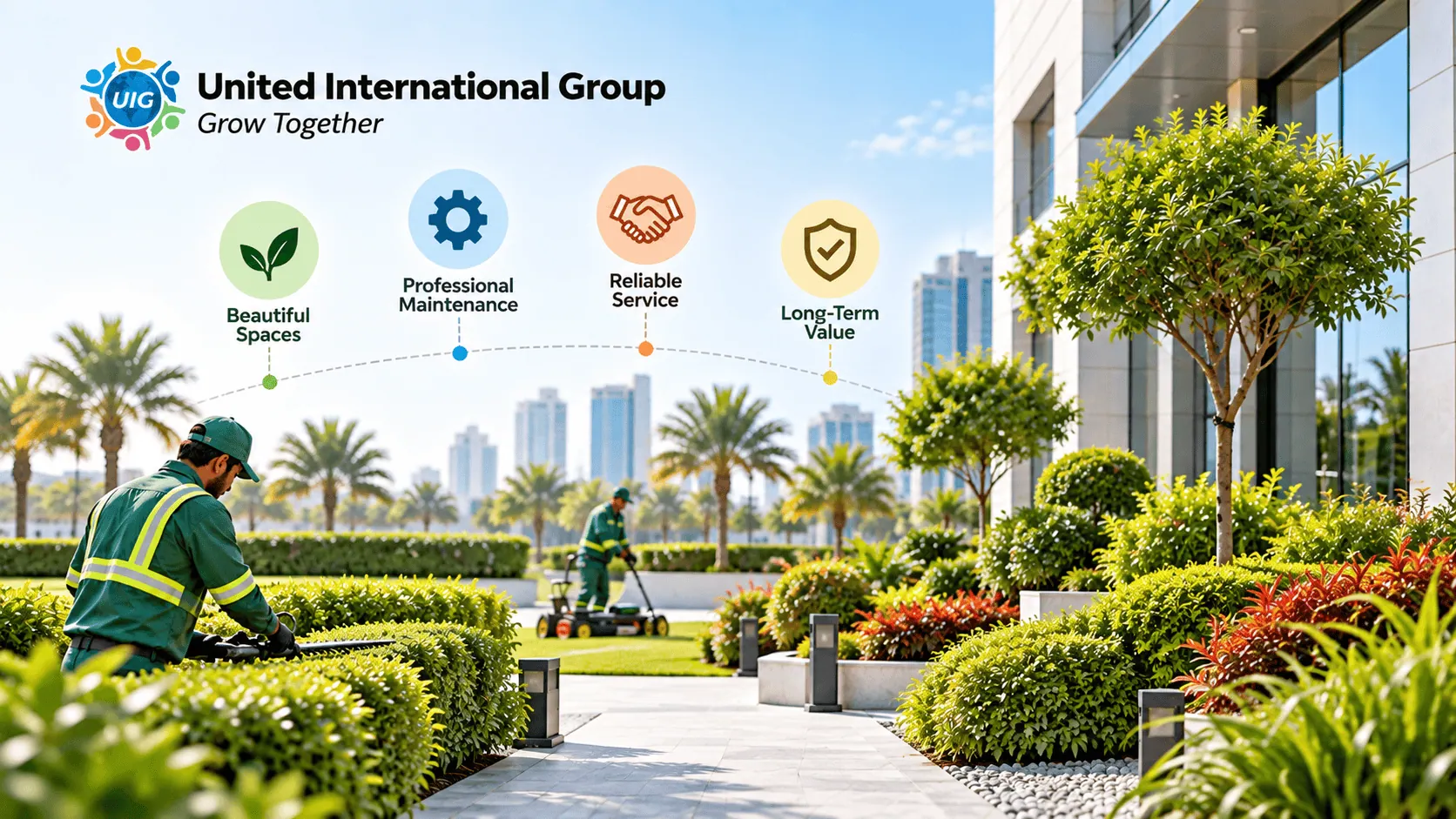
    Commercial Landscaping: How to Choose the Right Provider

    How to Choose a Commercial Landscaping Company

    The short answer: shortlist providers that cover softscape, hardscape and irrigation under one contract, know your local climate, put service levels in writing, and can show references from properties like yours. Compare price after that.

    1. Full scope under one contract

    Hiring a gardener, a paving contractor and an irrigation technician separately looks cheaper. It stops being cheaper when the paving crew cuts a drip line and nobody owns the repair. One provider for planting, hardscape and irrigation means one point of accountability.

    2. Irrigation expertise

    Ask about irrigation before you ask about plants. In an arid climate, water is the biggest running cost and the easiest to waste. Ask whether they install drip systems, how they detect leaks, and whether they fit timers and pump controls. If the answers are vague, you’re talking to a mowing crew, not a landscaping provider.

    3. Local climate knowledge

    Jeddah’s coastal humidity, Riyadh’s dry heat and temperature swings, and Jubail’s industrial setting each call for different plant choices and soil preparation. Ask which species they’d specify for your site and why. A generic plant list is a warning sign.

    4. Own crews and equipment

    Ask whether the provider runs its own trained crews and maintains its own tools, or subcontracts the work. If you’re searching for commercial landscaping equipment suppliers, you may be about to buy mowers and trimmers yourself. That only makes sense if you plan to hire and supervise gardeners in-house. For most facility managers, outsourcing is simpler.

    5. A written contract and SLA

    Look for a scope list, visit schedule, response time for irrigation failures, plant replacement terms and reporting. “Regular maintenance” is not a scope. Facility management bodies such as the International Facility Management Association publish guidance on holding outsourced providers to clear performance standards, and the principle applies here.

    6. References and reviews

    Reviews of commercial landscaping service providers in Riyadh or Jeddah are thin, because B2B clients rarely post them. Ask for references from similar properties and call two. Ask how long each client has held the contract. Long-term clients are the best review you’ll get.

    7. Track record

    When you search for the best commercial landscaping companies near you in Saudi Arabia, “best” should mean proven on sites like yours. UIG has served clients since 2011, completed 425+ projects and worked with 250+ corporate clients across commercial, hospitality, industrial and institutional facilities.

    Commercial Landscaping Contracts Compared

    Which contract is right? It depends on whether you need ongoing care, a short-term boost or a one-time build. UIG offers all three.

    Contract typeBest forConfirm before signing
    Annual maintenance contractOffices, hotels, malls and campuses needing year-round careScope, visit schedule, SLA, response times
    Seasonal maintenance packageSites with peak-season needs or tighter budgetsWhich months are covered, renewal terms
    One-off projectNew installations, renovation, redesignDeliverables, handover, defect period

    Most commercial sites do better on annual contracts. Plants and irrigation don’t pause between seasons, and gaps in care are where expensive damage starts.

    How Much Does Commercial Landscaping Cost in Saudi Arabia?

    The short answer: there’s no flat rate. The cost of commercial landscape maintenance in Jeddah, Riyadh or Jubail depends on:

    • Site size and layout
    • Plant mix (lawns need far more water and mowing than xeriscape)
    • Type and condition of the irrigation system
    • Visit frequency and crew size
    • Hardscape features that need upkeep
    • Contract length

    “Affordable” shouldn’t mean “lowest quote.” Cheap bids often leave out irrigation checks or plant replacement, then bill them later as variations. Ask for an itemised quote and compare scope line by line, not the total. Water-wise design also lowers running costs over time, which is where the real savings sit.

    Sustainable Commercial Landscaping and Irrigation

    Landscaping at property level sits inside a bigger national push. The Saudi Green Initiative aims to expand green cover across the Kingdom, so water-efficient design is becoming the baseline, not a bonus.

    Best practices for sustainable commercial landscaping in Riyadh and elsewhere:

    • Xeriscape design: drought-tolerant plants grouped by water need
    • Drip irrigation for beds, shrubs and trees: water goes to the roots, not the air
    • Sprinklers only where lawn is unavoidable: with timers and pump controls
    • Routine leak detection: a small leak runs for weeks if nobody looks
    • Soil preparation and mulching: holds moisture and suppresses weeds

    For large commercial properties, the usual split is drip for planting beds and trees, and sprinklers for open lawn areas. Both should run on controllers, not manual valves. Water use rules and conservation guidance come from the Ministry of Environment, Water and Agriculture, so check current requirements before specifying a system.

    In our experience, the first thing worth checking on a struggling site isn’t the plants. It’s the irrigation. One leaking line or a mistimed controller explains a lot of what looks like plant failure.

    Conclusion

    Choosing a commercial landscaping provider comes down to a few checks: full scope under one contract, real irrigation expertise, local climate knowledge, a written SLA, and references you can call. Price matters, but only after those are covered.

    UIG has delivered landscaping and facility services across Saudi Arabia since 2011, with 425+ projects completed for 250+ corporate clients. Whether your property is in Jeddah, Riyadh or Jubail, our team can scope an annual contract, seasonal package or one-off project around your site and budget.

    Request a landscaping quote from UIG

    Frequently Asked Questions

    What is commercial landscaping?
    Commercial landscaping is the professional design, installation and maintenance of outdoor spaces at non-residential properties such as offices, retail centers, hotels and industrial facilities. It covers softscape, hardscape and irrigation.

    How do I choose a commercial landscaping company?
    Check that they cover planting, hardscape and irrigation, know your local climate, offer a written SLA, and can provide references from similar properties. Compare itemised scope before comparing price.

    How much does commercial landscaping cost in Saudi Arabia?
    There’s no fixed price. Cost depends on site area, plant selection, irrigation type, visit frequency and contract length. Request an itemised quote based on a site visit.

    What does a commercial landscaping maintenance contract include?
    Typically mowing and edging, pruning, fertilisation, weed control, irrigation checks and plant replacement. The exact scope should be listed in the contract, along with visit frequency and response times.

    What irrigation system suits a large commercial property?
    Most large sites use drip irrigation for trees, shrubs and beds, and sprinklers for lawns, both controlled by timers. Drip delivers water directly to the roots and wastes less.

    How do I find affordable commercial landscaping near me?
    Request itemised quotes from two or three providers and compare scope, not just totals. Water-wise design and a preventive maintenance contract usually cost less over time than repeated repairs.

    Can commercial landscaping be sustainable in Saudi Arabia’s climate?
    Yes. Xeriscape design, drought-tolerant plants, drip irrigation, smart timers and leak detection cut water use while keeping the property green.

    When should I renovate a landscape instead of maintaining it?
    Renovate when plants keep dying despite proper care, irrigation is outdated or leaking repeatedly, or the layout no longer suits how the property is used.
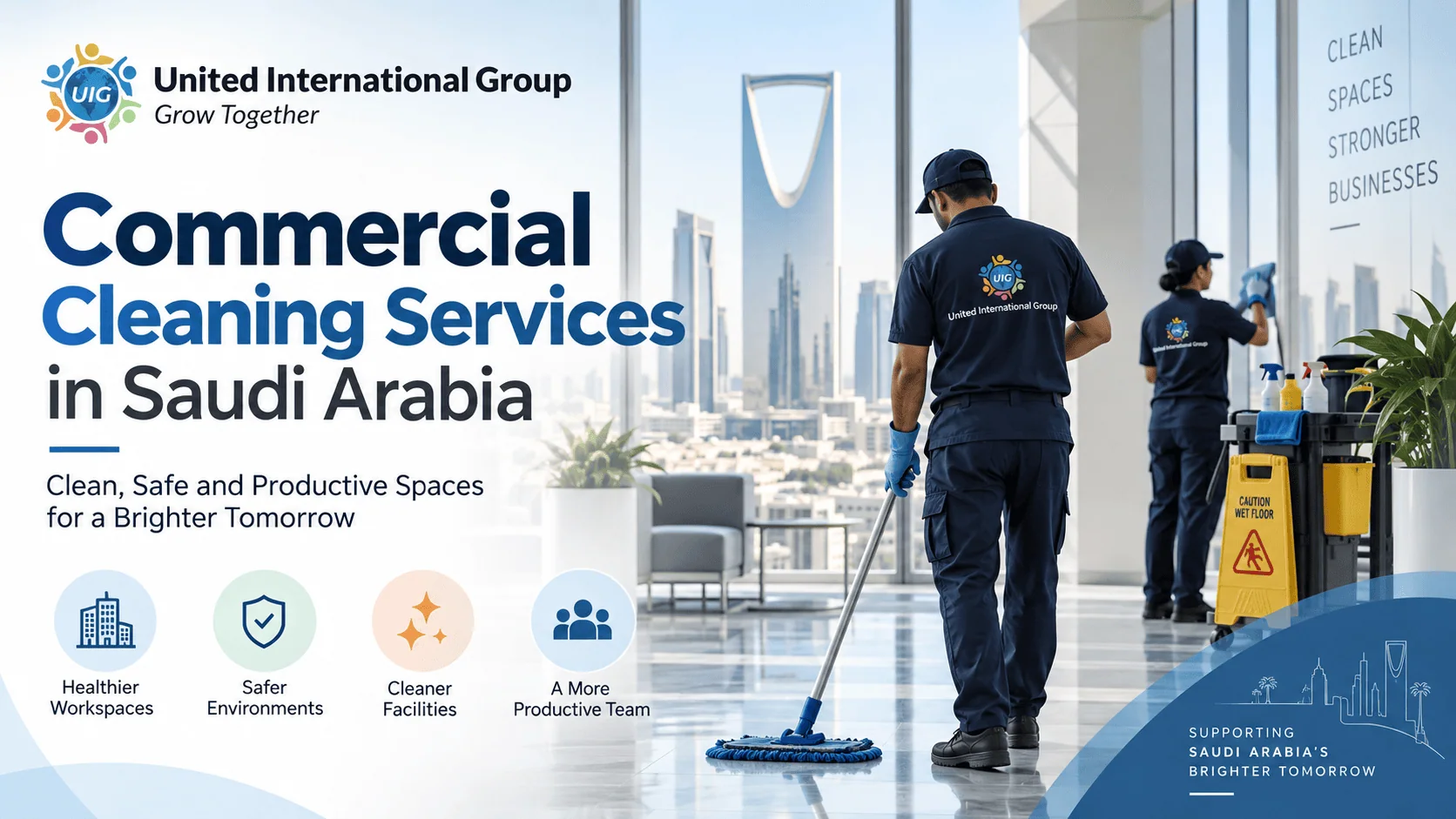
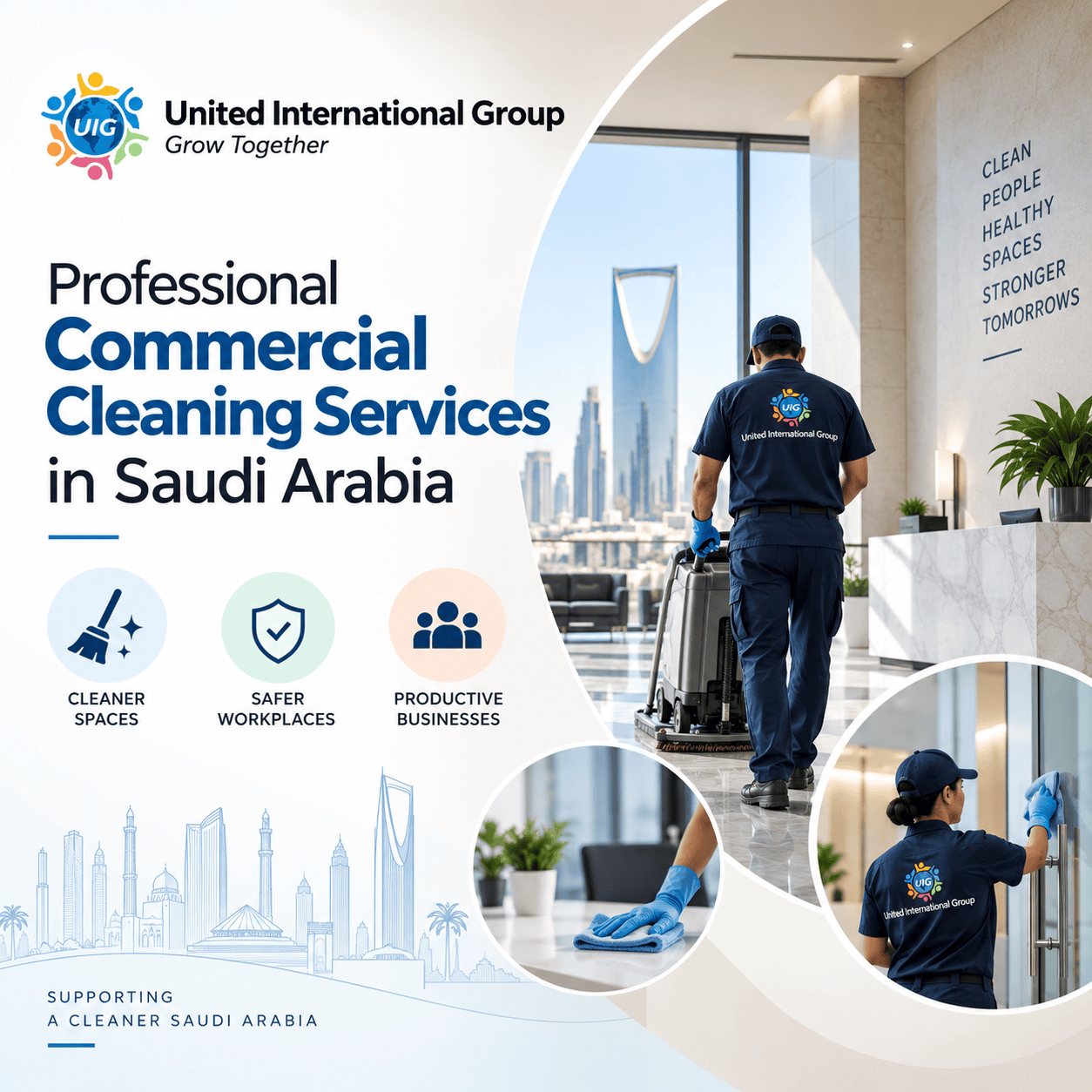
  • Commercial Cleaning Services in Saudi Arabia: What Every Business Needs to Know

    Commercial Cleaning Services in Saudi Arabia: What Every Business Needs to Know

    A dusty reception desk or a greasy restaurant kitchen tells customers more about a business than any advertisement. Across Saudi Arabia’s expanding commercial sector — from Riyadh’s office towers to Jeddah’s retail corridors and Jubail’s industrial parks — hygiene has become a measurable part of brand reputation, staff well being, and regulatory compliance.

    That’s why more facility managers, restaurant owners, and corporate leaders now rely on commercial cleaning services in Saudi Arabia instead of stretching an in-house team thin. Choosing the right provider means understanding what these services actually cover, how pricing works, and what separates a licensed cleaning company from a one-off contractor. Here’s a practical breakdown.

    What Are Commercial Cleaning Services?

    Commercial cleaning services are professional cleaning solutions delivered to businesses, offices, retail outlets, and industrial sites — not private homes. They’re carried out under a formal service contract, using trained staff and commercial-grade equipment, rather than the informal approach used in a household.

    What Does “Commercial Cleaning” Mean?

    Commercial cleaning means maintaining hygiene in a workplace or public-facing facility to a standard that supports health regulations, safety codes, and brand presentation — covering everything from daily office upkeep to industrial-grade sanitation.

    Is Commercial Cleaning the Same as Housekeeping?

    No. Housekeeping, or domestic cleaning, generally applies to a private residence on an informal basis. Commercial cleaning is scaled for larger facilities, follows documented procedures, and is backed by insurance, trained supervisors, and compliance with municipal health codes — requirements a domestic cleaner isn’t held to.

    What Are the Three Types of Cleaning?

    Cleaning is broadly grouped into three categories:

    •     Residential cleaning — private homes and apartments.

    •     Commercial cleaning — offices, retail, hospitality, and corporate facilities.

    •     Industrial cleaning — factories, warehouses, and heavy-duty sites requiring specialized equipment and safety protocols.

    Within commercial cleaning itself, providers typically offer three service tiers: routine janitorial cleaning, periodic deep cleaning, and specialized cleaning such as disinfection or post-construction cleanup.

    Commercial Cleaning Services in Saudi Arabia

    Key Differences Between Commercial and Domestic Cleaning

    •     Scale: commercial jobs cover large, high-traffic facilities; domestic cleaning covers a single household.

    •     Compliance: commercial cleaning must meet municipal and health-code requirements; domestic cleaning has no such obligation.

    •     Staffing: commercial cleaning uses trained, supervised teams rather than a single individual.

    •     Contracts: commercial cleaning runs on SLA-based agreements; domestic cleaning is usually informal.

    •     Equipment: commercial cleaning relies on industrial-grade machines — scrubber-dryers, HEPA vacuums, pressure washers — rarely found in a home.

    Commercial Cleaning Services List: What’s Included

    A commercial cleaning services company in Saudi Arabia typically offers a broad service list, tailored to the type of facility:

    What Is Included in Commercial Cleaning?

    •     Office and corporate cleaning — desks, pantries, meeting rooms, restrooms

    •     Retail and mall cleaning — high-footfall common areas, glass, flooring

    •     Restaurant and F&B cleaning — kitchens, grease traps, dining areas

    •     Healthcare and hospitality cleaning — infection-control protocols

    •     Industrial and warehouse cleaning — floors, machinery surrounds, waste zones

    •     Post-construction cleaning — debris removal, dust extraction, handover cleaning

    •     Window and facade cleaning

    •     Carpet, upholstery, and floor care

    •     Disinfection and sanitation services

    What Does a Commercial Cleaner Do?

    A commercial cleaner’s daily tasks typically include dusting and wiping surfaces, vacuuming and mopping floors, restocking restroom and pantry supplies, emptying waste bins, disinfecting high-touch points such as door handles and shared equipment, and reporting maintenance issues to the facility management team.

    Commercial Cleaning Services for Restaurants

    Restaurant cleaning carries its own compliance weight. Beyond general tidiness, it covers kitchen hood and grease-trap degreasing, food-contact surface sanitation, walk-in cooler hygiene, and pest-prevention housekeeping — all of which feed directly into municipal health inspections and food-safety licensing. A missed grease-trap cleaning cycle isn’t just a hygiene issue in Saudi Arabia’s F&B sector; it’s a compliance risk that can shut a kitchen down.

    How Much Do Commercial Cleaning Services Cost in Saudi Arabia?

    Commercial cleaning services prices in Saudi Arabia depend on facility size, cleaning frequency, service scope, and location — there’s no flat, one-size-fits-all number. Most providers price by square meter, by staff count deployed, or as a fixed monthly retainer for ongoing facility management contracts.

    What Affects Commercial Cleaning Services Cost?

    •     Facility size and layout — open-plan offices cost less per sq m than segmented retail units

    •     Cleaning frequency — daily versus three-times-weekly versus weekly service

    •     Scope — routine janitorial work versus deep cleaning versus specialized disinfection

    •     Staffing model — a dedicated on-site team versus a shared rotational crew

    •     Location — pricing in Riyadh, Jeddah, and Jubail can vary with local labor availability and site accessibility

    Commercial Cleaning Services Hourly Rate

    Cleaning staff wages in the Saudi market generally sit between roughly SAR 1,500 and SAR 3,600 per month, depending on experience, whether accommodation and food are included, and the employer’s service tier — an approximate hourly equivalent of SAR 8 to SAR 17 for standard shifts.

    Specialized roles, such as upholstery technicians or industrial cleaning crews, are priced higher. These are general market benchmarks rather than a quote, so it’s worth requesting a facility-specific estimate rather than budgeting off an average.

    Commercial Cleaning Contracts: What to Expect

    Most integrated facility management providers structure commercial cleaning contracts as:

    •     Annual or multi-year SLA-based agreements — most common for corporate and industrial clients

    •     Monthly retainer contracts — typical for smaller offices or retail units

    •     Per-project agreements — for one-off deep cleans or post-construction cleanup

    A well-written contract defines cleaning frequency, response times for ad-hoc requests, staffing levels, quality-inspection checkpoints, and liability and insurance coverage — not just a price line.

    Choosing a Commercial Cleaning Services Company in Saudi Arabia

    Most facility managers start their search by typing “commercial cleaning services near me” into Google. That instinct makes sense for a single retail unit, but for multi-site businesses, proximity matters less than consistency. A provider covering a 5-mile radius around a downtown Riyadh office needs to hold the same quality standard as one servicing a 20-mile industrial corridor near Jubail — coverage and reliability count for more than which office happens to be closest.

    What to Look For in a Commercial Cleaning Services Company

    •     Registered, insured operations with verifiable experience in Saudi Arabia

    •     Trained, supervised staff — not informal day labor

    •     Documented quality checklists and inspection reporting, not just “cleaned” as a checkbox

    •     Coverage across the cities you operate in, including Riyadh, Jeddah, and Jubail

    •     Ability to scale from a single office to a multi-site portfolio without losing consistency

    Providers that align their procedures with standards set by ISSA, the worldwide cleaning industry association, are more likely to follow documented, auditable cleaning practices.

    In-House vs. Outsourced Commercial Cleaning

    FactorIn-House CleaningOutsourced Commercial Cleaning
    StaffingRecruited and managed internallyManaged by the provider under an SLA
    Cost structureFixed payroll plus equipment overheadPredictable, contract-based pricing
    ScalabilitySlow to scale across new sitesScales as your facility footprint grows
    ComplianceFalls on the internal HR/HSE teamProvider carries compliance responsibility
    CoverageLimited to available staffBacked by a wider trained workforce pool

    Commercial Cleaning Services in 2026: Professional Solutions for Modern Workspaces

    The commercial cleaning services business in Saudi Arabia is being reshaped by three forces: Vision 2030’s construction boom, tighter municipal hygiene enforcement, and rising demand for outsourced facility services.

    According to P&S Intelligence’s Saudi Arabia Facility Management Market report, the local facility management market was valued at roughly USD 49.6 billion in 2025 and is projected to grow at a 10.4% CAGR through 2032, with the commercial segment already holding the largest share.

    Cleaning is one of the fastest-growing service lines within that shift, as offices, hotels, hospitals, and industrial sites move from informal, in-house cleaning toward contracted providers.

    For modern workspaces, that translates into:

    •     Eco-friendly, low-VOC cleaning products replacing harsh chemical agents

    •     Scheduled, data-logged cleaning through CAFM-linked reporting instead of unverified spot checks

    •     Hybrid-office cleaning patterns adjusted to actual occupancy rather than a fixed daily routine

    •     Hospital-grade disinfection protocols carried over into corporate and retail settings

    •     Cleaning bundled into broader integrated facility management contracts alongside MEP maintenance, fire fighting systems, and landscaping, rather than procured as a separate line item

    Why Businesses Choose UIG for Commercial Cleaning Services in Saudi Arabia

    United International Group (UIG) has delivered integrated facility management services across Saudi Arabia since 2011, with 425+ completed projects and 250+ corporate clients across Riyadh, Jeddah, Jubail, and beyond.

    Commercial cleaning at UIG isn’t a standalone add-on — it’s delivered alongside MEP maintenance, fire fighting systems, landscaping, and soft FM services, so facility managers get one accountable provider instead of juggling multiple vendors. Contracts are built around documented SLAs, trained and supervised cleaning crews, and regular quality audits — the same standards outlined throughout this guide.

    UIG Blog CTA – Integrated Facility Management

    Talk to UIG

    Ready for a cleaning partner backed by 15 years and 425+ projects across Saudi Arabia?

    Talk to UIG’s facility management team today.

    Frequently Asked Questions

    What is the meaning of commercial cleaning services?

    Commercial cleaning services refer to professional cleaning solutions delivered to businesses and public-facing facilities — offices, retail spaces, restaurants, and industrial sites — under a formal contract, using trained staff and commercial-grade equipment, rather than informal home cleaning.

    What are the three types of cleaning?

    The three broad categories are residential cleaning (homes), commercial cleaning (offices, retail, hospitality), and industrial cleaning (factories, warehouses, and heavy facilities). Commercial cleaning itself is further divided into routine, deep, and specialized cleaning.

    Is commercial cleaning the same as housekeeping?

    No. Housekeeping typically applies to private residences on an informal basis, while commercial cleaning is scaled for larger facilities, follows documented safety procedures, and is backed by insurance and municipal compliance requirements.

    What are the key differences between commercial cleaning and domestic cleaning?

    Commercial cleaning covers larger spaces, uses trained and supervised teams, runs on SLA-based contracts, and must meet municipal hygiene codes. Domestic cleaning is smaller in scale, usually informal, and carries no regulatory compliance requirement.

    How much is the salary of cleaners in KSA, and what do cleaners earn per hour?

    Cleaning staff salaries in Saudi Arabia generally range between roughly SAR 1,500 and SAR 3,600 per month depending on experience, employer, and whether food and accommodation are included — an approximate hourly equivalent of SAR 8 to SAR 17. Rates vary by role, city, and contract type, so treat this as a market benchmark rather than a fixed figure.

    What are examples of commercial cleaning, and what is included?

    Examples include office and corporate cleaning, restaurant and kitchen cleaning, retail and mall cleaning, industrial and warehouse cleaning, post-construction cleanup, window and facade cleaning, carpet and upholstery care, and disinfection services.

    What does a commercial cleaner do?

    A commercial cleaner dusts and sanitizes surfaces, vacuums and mops floors, restocks restroom and pantry supplies, empties waste bins, disinfects high-touch points, and reports maintenance issues to the facility team.

    How much do commercial cleaning services cost in Saudi Arabia?

    Cost depends on facility size, cleaning frequency, scope of work, and staffing model. Most providers price by square meter, staff count, or a fixed monthly retainer — request a site-specific quote rather than relying on a flat industry average.

  • HVAC Maintenance Checklist for Saudi Buildings: What Facility Managers Need to Know

    HVAC Maintenance Checklist for Saudi Buildings: What Facility Managers Need to Know

    If your building’s AC fails in July, you don’t get a grace period. Saudi officials have put the Kingdom’s cooling load at around 70% of total electricity consumption, and most of that draw happens in commercial and residential buildings that can’t afford downtime. A solid HVAC maintenance checklist is what separates a system that quietly does its job for years from one that fails on the hottest day of the year, in front of tenants, guests, or a production line.

    This guide breaks down what a proper HVAC maintenance checklist covers for buildings in Saudi Arabia’s climate, how often to run it, what it costs, and how to choose a maintenance partner who won’t leave you stuck mid-summer.

    Why HVAC Maintenance Works Differently in Saudi Arabia

    Saudi Arabia’s climate is harder on HVAC equipment than almost anywhere else. Summer temperatures above 45°C push compressors and condensers to run near-continuously for months. Dust and sandstorms clog filters and coils faster than in temperate climates, and in high-dust regions filters need checking every two to three weeks, not once a quarter. Coastal cities like Jeddah add humidity and salt air, which corrode coils and electrical components over time.

    Saudi Arabia’s building code applies to the design, operation, and maintenance of buildings across the Kingdom, including mechanical and HVAC systems, and places that responsibility on the building owner. That’s a maintenance obligation tied to occupancy and safety compliance, whether the building sits in Riyadh, Jeddah, Jubail, or anywhere else in the Kingdom.

    The Complete HVAC Maintenance Checklist for Saudi Buildings

    An HVAC maintenance checklist is a structured list of inspection, cleaning, and testing tasks performed on a set schedule to keep heating, ventilation, and air conditioning systems running safely and efficiently. In Saudi Arabia’s climate, that schedule needs to be tighter than in most countries.

    Monthly HVAC Maintenance Check

    • Inspect and clean or replace air filters (every 2–4 weeks in high-dust areas)
    • Check condensate drain lines for blockages
    • Listen for unusual noise or vibration from indoor and outdoor units
    • Confirm thermostat and control settings match occupancy schedules

    Quarterly HVAC Maintenance and Cleaning

    • Clean evaporator and condenser coils
    • Check refrigerant levels and inspect for leaks
    • Inspect belts, pulleys, and bearings for wear
    • Test electrical connections and capacitors
    • Inspect ductwork for dust buildup and leaks — this is where HVAC maintenance and duct cleaning becomes essential given how much dust infiltrates Saudi buildings year-round

    Before Summer: Annual HVAC Maintenance Check

    • Full system performance test ahead of peak load
    • Deep-clean coils and ducts
    • Calibrate thermostats and sensors
    • Check insulation on refrigerant lines
    • Verify backup or redundant cooling capacity where it matters most: hospitals, data centers, malls

    Before Winter: Off-Season HVAC Maintenance

    • Inspect heating elements and heat pumps
    • Clean and seal ductwork before it sits idle
    • Check for corrosion caused by summer humidity
    • Schedule major repairs while cooling demand is lower
    HVAC Maintenance Checklist for Saudi Buildings

    HVAC Maintenance and Repair: Where One Ends and the Other Begins

    HVAC maintenance and repair aren’t the same service, and treating them as interchangeable is how buildings end up with the same failure twice.

    Maintenance is preventive: scheduled inspections, cleaning, and small adjustments that stop failures before they start. Repair is reactive: fixing something that has already broken, whether that’s a failed compressor, a refrigerant leak, or an electrical fault.

    HVAC maintenance best practices catch most of what would otherwise become a repair call. A well-run preventive maintenance program generally means fewer emergency repairs, shorter equipment downtime, and equipment that reaches or exceeds its expected service life.

    That’s one of the clearest benefits of HVAC maintenance done on a schedule, rather than only when something stops working. Many facility teams also benchmark their internal schedules against ASHRAE’s commercial HVAC maintenance guidelines when building out a contract’s scope.

    HVAC Maintenance Cost in Saudi Arabia

    HVAC maintenance cost in Saudi Arabia depends on building size, system type, unit count, and whether you’re paying per visit or under a contract. As a general pattern:

    • Reactive, one-off repairs cost more per incident than routine maintenance, and tend to happen during peak summer load, when they’re hardest to schedule around.
    • A maintenance contract spreads cost across the year and usually works out lower than the same volume of reactive repairs, since problems get caught while they’re still cheap to fix.
    • Annual HVAC maintenance cost scales with unit count, ductwork complexity, and system age; older systems generally need more frequent attention.
    Cost DriverImpact on Maintenance Cost
    Building size / unit countMore units raise total contract cost, but lower the cost per unit
    System typeCentral and VRF systems typically cost more per visit than standalone split units
    System ageOlder systems need more frequent, more involved servicing
    Contract vs. pay-per-visitA contract typically costs less over a year than the same repairs paid individually

    Because pricing depends on your building’s actual systems, exact figures should come from a site assessment rather than an industry average. A maintenance quote from UIG gives you a cost breakdown based on your equipment, not a generic estimate.

    HVAC Maintenance Agreement vs. One-Off Repairs

    An HVAC maintenance agreement is a contract that locks in scheduled servicing, usually monthly filter checks plus quarterly and seasonal deep maintenance, for a fixed period, typically 12 months.

    A solid HVAC maintenance contract should specify:

    • Exact scope: what’s inspected, cleaned, and tested at each visit
    • Response time for emergency calls
    • Parts and labor coverage for common wear items
    • Reporting: a maintenance log you can reference for compliance and audits

    The main advantage over one-off repairs is predictability. You know what’s covered, what a visit costs, and when it happens, instead of discovering a problem only after the system has already failed.

    Choosing an HVAC Maintenance Company in Saudi Arabia

    Not every HVAC maintenance company in Saudi Arabia can handle commercial-scale systems in Riyadh, Jeddah, or Jubail. Before signing, check for:

    • Certified technicians trained on your system type (split, central, or VRF)
    • A track record with buildings like yours: offices, retail, hospitality, industrial
    • Working knowledge of the Saudi Building Code’s mechanical requirements
    • Response times matched to your risk tolerance; a hospital and a warehouse don’t need the same SLA
    • Transparent reporting, not just a signature on a visit sheet

    United International Group has delivered integrated facility management services, including MEP and HVAC maintenance, across Saudi Arabia since 2011, with 425+ completed projects for corporate clients in Riyadh, Jeddah, Jubail, and beyond.

    If you’re looking for an HVAC maintenance company that treats maintenance as a scheduled discipline rather than a callback service, that’s where UIG’s facility management team comes in.

    Conclusion

    A working HVAC maintenance checklist isn’t a formality. In a climate where cooling accounts for most of a building’s electricity use, it’s what keeps tenants comfortable, equipment protected, and operating costs predictable. Whether you manage a single commercial tower in Riyadh or a portfolio spread across Jeddah and Jubail, the difference between a maintenance contract and reactive repairs usually shows up as one large, avoidable bill.

    UIG has run HVAC and MEP maintenance programs across Saudi Arabia since 2011, completing 425+ facility management projects for corporate clients across the Kingdom.

    UIG Blog CTA – Integrated Facility Management

    Talk to UIG

    Need a Maintenance Plan Built Around Your Building?

    UIG has managed HVAC and MEP maintenance for 425+ projects across Saudi Arabia since 2011. Get a maintenance plan scoped to your building’s actual systems — not a generic package.

    Frequently Asked Questions

    Q. What is HVAC maintenance?
    HVAC maintenance is the routine inspection, cleaning, and servicing of heating, ventilation, and air conditioning equipment to keep it running safely and efficiently. It includes filter changes, coil cleaning, refrigerant checks, and electrical testing, done on a set schedule rather than only after something breaks.

    Q. What’s included in an HVAC maintenance checklist?
    A standard checklist covers filter inspection, coil cleaning, refrigerant level checks, condensate drain clearing, electrical and belt inspection, thermostat calibration, and ductwork review. In Saudi Arabia, filter and duct cleaning need to happen more often because of dust.

    Q. How often should HVAC systems be serviced in Saudi Arabia?
    Most commercial systems need monthly filter checks, quarterly maintenance visits, and a full inspection before the summer peak. The Saudi Building Code requires mechanical systems, including HVAC, to stay in proper operating condition for as long as they’re in use.

    Q. What is the difference between AC and HVAC?
    AC only cools the air. HVAC covers the full system: heating, cooling, and air circulation working together to control a building’s indoor climate.

    Q. What are the three main types of HVAC systems?
    Split systems, with separate indoor and outdoor units; packaged or central systems, with components in one unit or a centralized plant; and VRF (variable refrigerant flow) systems, common in larger Saudi commercial buildings for zone-by-zone efficiency.

    Q. What is the $5,000 rule for HVAC?
    It’s a repair-versus-replace rule of thumb: multiply the unit’s age in years by the repair cost estimate. If the result tops roughly 5,000, replacement usually makes more sense than repair. Treat it as a guideline and confirm it against your actual equipment condition.

    Q. What skills should a qualified HVAC technician have?
    Electrical and mechanical troubleshooting, certified refrigerant handling, the ability to read system diagrams, working knowledge of local safety and code compliance, and clear reporting to facility managers.

    Q. What’s included in HVAC preventive maintenance?
    Scheduled inspections, cleaning of filters and coils, lubrication of moving parts, calibration of thermostats and sensors, and early replacement of worn components, all aimed at catching problems before they cause a breakdown.

  • Preventive MEP Maintenance: Why It Matters

    Preventive MEP Maintenance: Why It Matters

    MEP maintenance is usually noticed only when something stops working. The AC stops cooling during peak business hours. A pump fails and water pressure drops. A circuit trips again and nobody knows why. A small leak appears on the ceiling, and by the time someone checks it, the damage has already spread.

    That is the problem with Mechanical, Electrical, and Plumbing systems. They work quietly in the background until they do not.

    Preventive MEP maintenance helps building owners, facility managers, and business operators catch these problems before they turn into shutdowns, safety risks, tenant complaints, or expensive repairs. For facilities in Saudi Arabia, where cooling demand, dust exposure, and operational expectations are high, prevention is not just good practice. It is the difference between control and chaos.

    What Is MEP Maintenance?

    MEP maintenance means regularly inspecting, servicing, testing, and repairing a building’s Mechanical, Electrical, and Plumbing systems.

    These are the systems that make a building usable every day. They control air conditioning, ventilation, lighting, power, water supply, drainage, pumps, electrical panels, and many other essential functions.

    A building can look perfect from the outside and still have weak MEP systems behind the walls, above the ceiling, or inside the plant room.

    Good MEP maintenance keeps these systems stable, safe, and efficient.

    It usually includes:

    • HVAC inspection and servicing
    • Chiller, AHU, and FCU maintenance
    • Electrical panel inspection
    • Generator and UPS testing
    • Lighting system checks
    • Plumbing leak detection
    • Pump and valve maintenance
    • Drainage inspection
    • Water pressure checks
    • Equipment cleaning and calibration
    • Emergency repair support
    • Maintenance reporting and documentation

    In simple words, MEP maintenance keeps the building’s core systems healthy.

    Preventive MEP Maintenance: Why It Matters

    What Does MEP Include?

    MEP includes three major parts: Mechanical, Electrical, and Plumbing.

    Each one has a different role, but they are deeply connected. When one fails, the others can also be affected.

    Mechanical Systems: Cooling, Ventilation, and Air Movement

    Mechanical systems mainly include HVAC systems. HVAC stands for Heating, Ventilation, and Air Conditioning.

    In Saudi Arabia, this is one of the most critical parts of any building because cooling systems often run for long hours. A poorly maintained HVAC system does not just affect comfort. It can increase electricity bills, reduce indoor air quality, and shorten equipment life.

    Mechanical maintenance may include:

    • Cleaning or replacing air filters
    • Inspecting air handling units
    • Servicing fan coil units
    • Checking chillers and cooling towers
    • Cleaning condenser and evaporator coils
    • Testing thermostats and sensors
    • Checking belts, bearings, and motors
    • Inspecting ductwork and airflow
    • Maintaining exhaust and ventilation systems

    A simple example: if AC filters are blocked, the system has to work harder to push air. That means higher power use, weaker cooling, and more stress on the equipment. One small neglected filter can slowly become a much bigger cost.

    Electrical Systems: Power, Safety, and Backup Support

    Electrical systems power almost everything inside a facility.

    They support lighting, HVAC, elevators, pumps, machinery, security systems, IT rooms, kitchen equipment, medical equipment, and backup power systems.

    Electrical maintenance is not an area where guesswork is acceptable. A loose connection, overloaded panel, weak breaker, or poor grounding can create serious safety risks.

    Electrical MEP maintenance may include:

    • Electrical panel inspection
    • Circuit breaker testing
    • Generator maintenance
    • UPS inspection
    • Cable and wiring checks
    • Earthing and grounding inspection
    • Load testing
    • Lighting maintenance
    • Infrared thermal scanning
    • Power distribution checks

    For example, a commercial building may not notice an overheating panel immediately. But over time, that heat can damage components, increase fire risk, and lead to sudden power failure. Preventive inspection helps catch these warning signs early.

    Plumbing Systems: Water Supply, Drainage, and Flow Control

    Plumbing systems manage water movement throughout the building.

    This includes water supply lines, drainage systems, pumps, valves, tanks, heaters, and wastewater systems. Plumbing problems can spread quickly because water damage rarely stays in one place.

    Plumbing maintenance may include:

    • Leak detection
    • Pipe inspection
    • Drainage cleaning
    • Pump servicing
    • Valve testing
    • Water pressure checks
    • Tank and water system support
    • Sewage line inspection
    • Water heater maintenance
    • Preventive checks for corrosion or blockage

    A small leak above a ceiling can damage tiles, wiring, furniture, walls, and flooring. By the time it becomes visible, the cost is already higher than it needed to be.

    Why Preventive MEP Maintenance Matters

    Preventive MEP maintenance matters because buildings do not fail all at once. They usually give warnings first.

    The AC starts taking longer to cool. A pump becomes noisy. The electricity bill rises. A breaker trips once, then twice. Water pressure drops. Tenants complain about bad smell from drains.

    These are not random issues. They are early signs.

    Preventive maintenance gives facility managers a chance to act before the problem becomes urgent.

    It helps with:

    • Fewer unexpected breakdowns
    • Lower emergency repair costs
    • Better safety
    • Better energy performance
    • Longer equipment life
    • Fewer tenant or customer complaints
    • Better budget planning
    • Cleaner maintenance records
    • More reliable facility operations

    Reactive maintenance means waiting for failure. Preventive maintenance means managing risk before failure.

    Preventive MEP Maintenance vs Reactive Maintenance

    FactorPreventive MEP MaintenanceReactive Maintenance
    TimingPlanned before failureDone after something breaks
    CostMore predictableUsually higher and urgent
    DowntimeLower riskHigher risk
    SafetyProblems found earlyRisks may stay hidden
    Equipment LifeHelps extend lifespanSpeeds up wear and tear
    Business ImpactLess disruptionCan stop operations
    Best UseCritical building systemsEmergency repairs only

    Reactive maintenance will always exist because unexpected issues can happen. But it should not be the main strategy for HVAC, electrical, plumbing, pumps, chillers, generators, or other critical assets.

    A building that depends only on emergency repairs is usually spending more than it realizes.

    Why MEP Maintenance Is Especially Important in Saudi Arabia

    Buildings in Saudi Arabia face demanding operating conditions.

    In cities like Jeddah, Riyadh, Jubail, and across the Eastern Province, facilities often deal with high cooling loads, dust, long equipment operating hours, and large-scale commercial or industrial use.

    HVAC systems work harder. Filters collect dust faster. Outdoor equipment faces heat exposure. Industrial facilities may need more frequent inspection. Commercial buildings need consistent comfort because customer and tenant expectations are high.

    For Saudi businesses, preventive MEP maintenance helps reduce:

    • AC breakdowns during peak heat
    • High energy consumption
    • Electrical faults caused by overloaded systems
    • Plumbing issues in high-occupancy buildings
    • Operational downtime in industrial facilities
    • Repeated emergency callouts
    • Long-term asset damage

    United International Group has been serving clients since 2011 as a facility management service provider in Saudi Arabia. That experience matters because MEP maintenance is not only about technical repair. It is about understanding how buildings actually operate day after day.

    What Should a Preventive MEP Maintenance Plan Include?

    A strong preventive maintenance plan should be clear, scheduled, and practical.

    It should not be a generic checklist copied from another building. A hospital, warehouse, office tower, hotel, and industrial site do not have the same risks.

    A proper MEP maintenance plan should include:

    1. Complete Asset List

    Every important system should be listed. This includes HVAC units, chillers, pumps, electrical panels, generators, water tanks, valves, and control systems.

    2. Maintenance Schedule

    Tasks should be divided into daily, weekly, monthly, quarterly, and annual checks.

    3. System-Based Checklists

    Mechanical, electrical, and plumbing systems should each have their own checklist.

    4. Emergency Response Process

    Even good buildings face emergencies. The plan should define who responds, how quickly, and what happens next.

    5. Maintenance Reports

    Reports should show what was inspected, what was repaired, what needs attention, and what should be planned next.

    6. Spare Parts Planning

    Critical parts should be identified in advance so repairs do not get delayed.

    7. Performance Review

    Recurring breakdowns, energy use, complaints, and asset condition should be reviewed regularly.

    Signs Your Facility Needs Better MEP Maintenance

    Some signs should not be ignored.

    Your building may need better MEP maintenance if you notice:

    • AC units cooling slowly
    • Sudden increase in electricity bills
    • Frequent breaker trips
    • Hot electrical panels
    • Water leaks or damp walls
    • Low water pressure
    • Noisy pumps or motors
    • Drainage smell
    • Uneven cooling in different areas
    • Generator starting issues
    • Repeated emergency repairs
    • Poor indoor air quality
    • Tenants or staff complaining often

    One issue may not seem serious. Repeated issues usually mean the building needs a better maintenance system.

    How Often Should MEP Maintenance Be Done?

    MEP maintenance frequency depends on the building type, system age, usage level, and risk.

    A small office may need a different schedule than a hospital, mall, hotel, or factory.

    A general structure may look like this:

    FrequencyTypical MEP Tasks
    DailyVisual checks, basic readings, urgent issue reporting
    WeeklyPump checks, filter condition, drainage and water pressure checks
    MonthlyHVAC servicing, electrical panel inspection, plumbing checks
    QuarterlyGenerator testing, deeper system inspection, performance review
    AnnuallyMajor servicing, compliance checks, asset condition review

    High-use facilities may need more frequent maintenance, especially for HVAC, electrical, and pump systems.

    How United International Group Supports MEP Maintenance

    United International Group provides integrated facility management services for businesses across Saudi Arabia.

    For MEP maintenance, the goal is simple: keep the facility running with fewer surprises.

    UIG supports clients with:

    • Preventive MEP maintenance
    • HVAC maintenance
    • Electrical maintenance
    • Plumbing maintenance
    • Facility inspections
    • Annual maintenance contracts
    • Emergency maintenance support
    • Planned maintenance scheduling
    • Maintenance reporting
    • Integrated facility management services

    A building has to stay safe, comfortable, and operational. The maintenance partner should make that easier, not more complicated.

    Need fewer breakdowns and better control over your building systems? Contact United International Group for a preventive MEP maintenance plan tailored to your facility.

    Conclusion

    MEP maintenance is not just a technical service. It protects the building, the people inside it, and the business that depends on it.

    When mechanical, electrical, and plumbing systems are maintained properly, the facility runs with fewer breakdowns, fewer complaints, lower risk, and better cost control. When they are ignored, the problems usually show up at the worst possible time.

    Preventive MEP maintenance gives facility owners and managers a better way to operate. It turns maintenance from a reaction into a plan.

    For businesses in Saudi Arabia, especially across Jeddah, Riyadh, Jubail, and the Eastern Province, this matters even more because building systems work hard every day.

    United International Group has been serving clients since 2011 with facility management services designed to keep buildings safer, cleaner, and more reliable.

    Contact United International Group today to schedule a facility assessment or request a customized MEP maintenance proposal.

    UIG Blog CTA – Integrated Facility Management

    Talk to UIG

    Need fewer breakdowns and better control over your building systems?

    Contact United International Group for a preventive MEP maintenance plan tailored to your facility.

    Frequently Asked Questions

    Q. What is MEP maintenance?

    MEP maintenance is the regular inspection and servicing of mechanical, electrical, and plumbing systems in a building.

    Q. What does MEP stand for?

    MEP stands for Mechanical, Electrical, and Plumbing.

    Q. Why is preventive MEP maintenance important?

    It helps prevent breakdowns, reduce repair costs, improve safety, and extend equipment life.

    Q. What is included in MEP maintenance?

    It includes HVAC servicing, electrical checks, plumbing inspection, pump maintenance, generator testing, and repair support.

    Q. How often should MEP maintenance be done?

    Most facilities need monthly, quarterly, and annual maintenance. High-use buildings may need more frequent checks.

    Q. Is preventive maintenance better than reactive maintenance?

    Yes. Preventive maintenance reduces risk before failure. Reactive maintenance happens after something has already broken.

    Q. Can MEP maintenance reduce energy bills?

    Yes. Clean, calibrated, and well-maintained systems usually consume less energy.

    Q. Which buildings need MEP maintenance?

    Offices, malls, hotels, hospitals, factories, schools, warehouses, residential compounds, and government buildings all need it.

  • How Cleaning Services Improve Workplace Productivity

    How Cleaning Services Improve Workplace Productivity

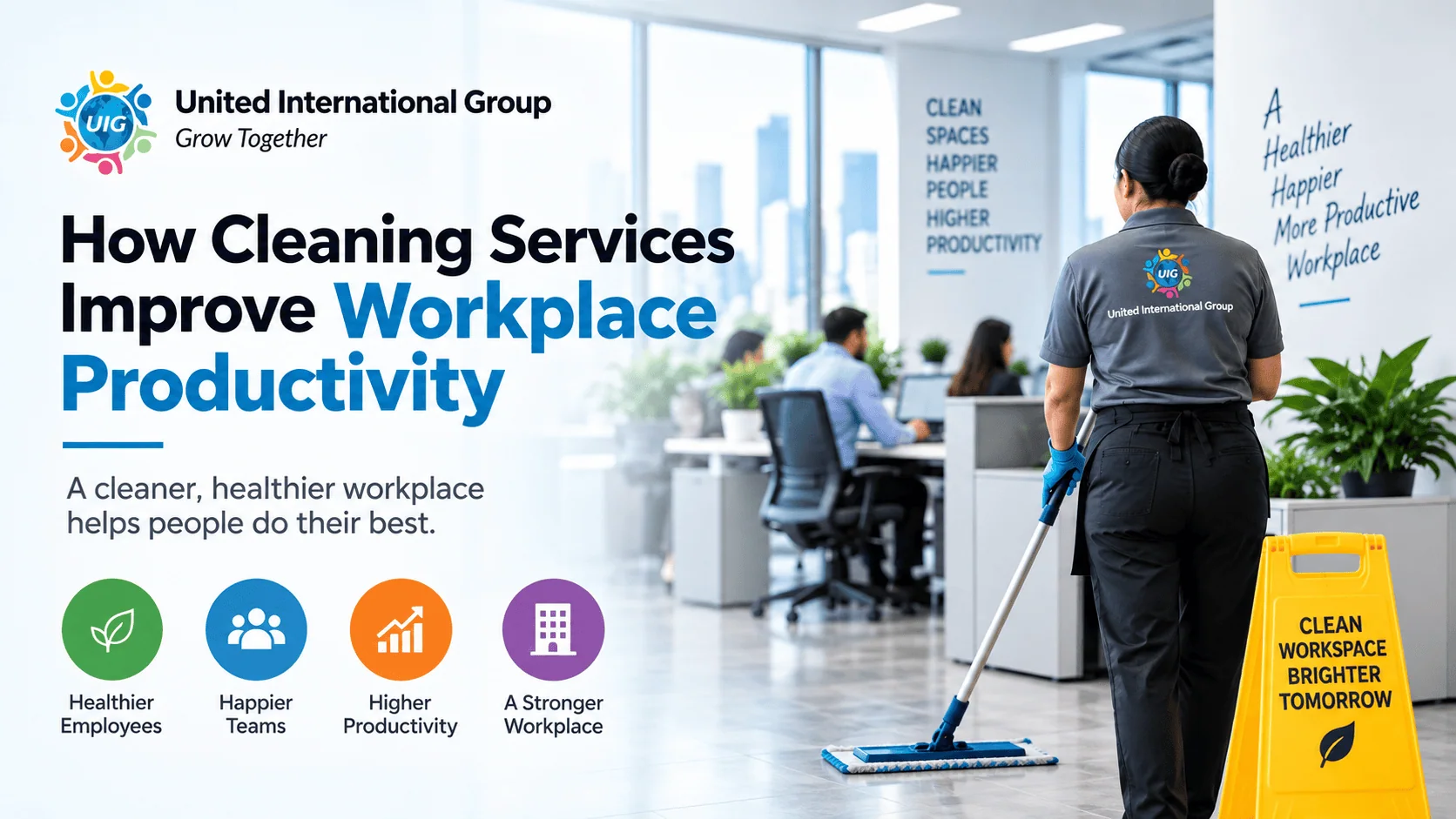
    A workplace does not need to look dirty to start affecting productivity. Sometimes it is the meeting room that always smells closed. The washroom that employees avoid. The pantry counter that is never fully clean. The dusty reception area that makes visitors question the company before the meeting even starts.

    That is why professional cleaning services matter. They do more than keep a space presentable. They help people work in a place that feels organized, safe, and cared for.

    For offices, hospitals, malls, hotels, schools, warehouses, and industrial facilities in Saudi Arabia, cleaning is not a small maintenance task. It is part of how the workplace functions every day.

    What Do Cleaning Services Have to Do With Productivity?

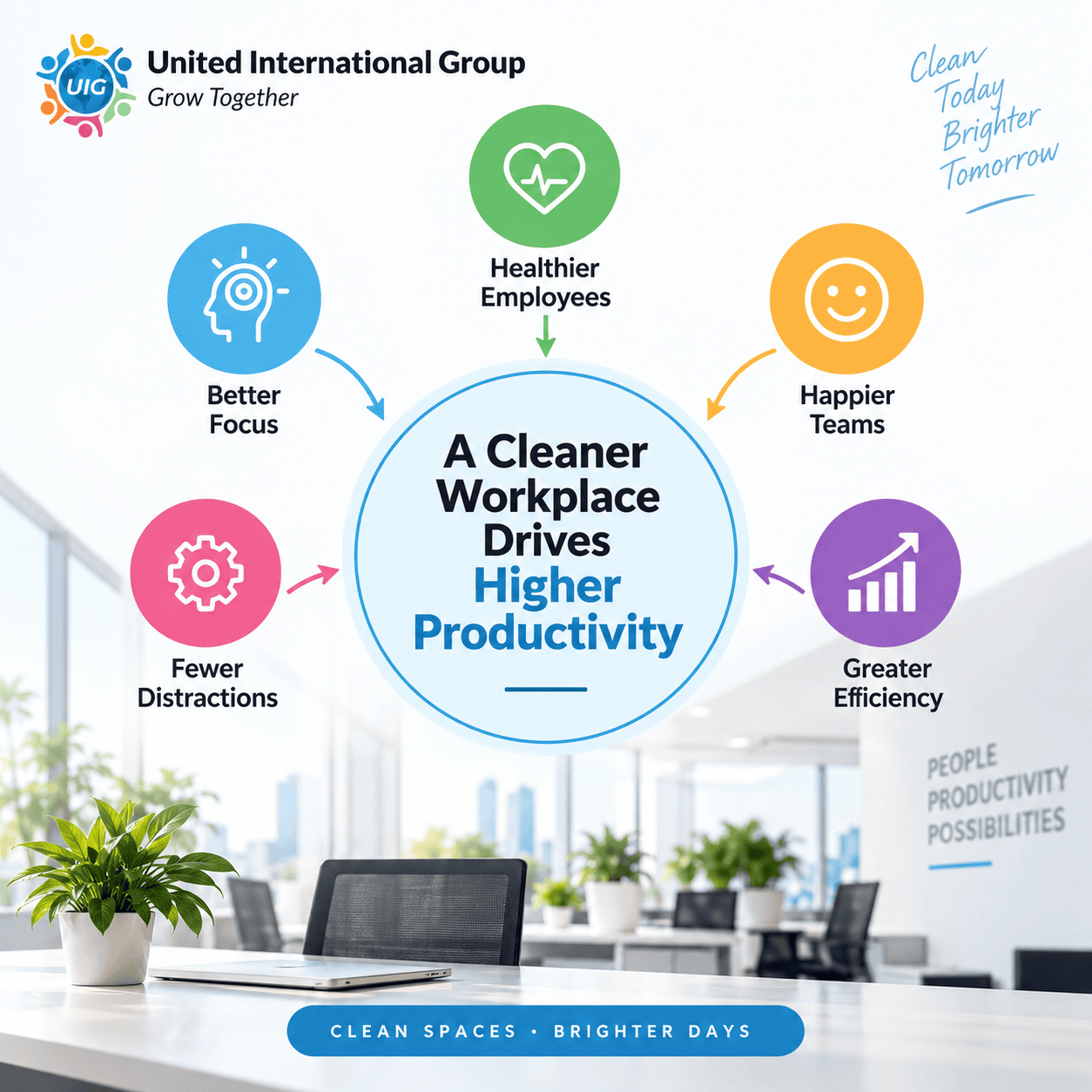
    Cleaning services improve productivity by removing distractions, reducing hygiene risks, and making the workplace easier to use.

    People work better in spaces that feel clean and controlled. They do not waste time complaining about the washroom, avoiding certain areas, wiping their own desks, or wondering whether a shared surface is hygienic.

    A professionally cleaned workplace helps with:

    • Better focus during work hours
    • Fewer hygiene-related complaints
    • More confidence in shared spaces
    • Cleaner meeting rooms for clients
    • Safer floors and walkways
    • Better employee morale
    • Stronger first impressions

    This is especially important in high-footfall workplaces. A small office may only need daily cleaning and occasional deep cleaning. A hospital, mall, hotel, school, or industrial site needs a more serious cleaning plan because the risk and usage levels are higher.

    Why Clean Workplaces Feel Easier to Work In

    A clean workplace reduces friction.

    That may sound simple, but it is a real operational issue. When a facility is not cleaned properly, small problems start taking attention away from actual work.

    Employees notice things like:

    • Dust on desks and screens
    • Overflowing bins
    • Sticky pantry counters
    • Dirty glass doors
    • Smelly washrooms
    • Stained carpets
    • Unclean lift buttons and handrails
    • Cluttered common areas

    None of these problems may stop work completely. But they create irritation. And when these issues happen every day, they affect how people feel about the workplace.

    A clean office tells employees one thing clearly: this place is managed properly.

    That matters. People are more likely to respect a space that is already cared for.

    How Cleaning Services Improve Workplace Productivity

    How Professional Cleaning Reduces Sick Days and Disruptions

    Professional cleaning helps reduce the spread of germs by focusing on the areas people touch the most.

    In most workplaces, the biggest hygiene risks are not hidden in corners. They are right in front of everyone.

    High-touch areas include:

    • Door handles
    • Lift buttons
    • Reception counters
    • Meeting tables
    • Light switches
    • Pantry surfaces
    • Washroom taps
    • Handrails
    • Shared phones
    • Biometric machines
    • Desk surfaces

    When these areas are cleaned casually, germs spread easily. One sick employee can affect a whole team, especially in offices, schools, call centers, hospitals, and shared workspaces.

    The CDC recommends paying special attention to high-touch surfaces, especially in busy facilities. The EPA also highlights that people spend most of their time indoors, which makes indoor cleanliness and air quality important for health and comfort.

    For businesses, this is not only a health issue. It is a productivity issue.

    When employees are absent, deadlines slow down. When teams are short-staffed, customer service suffers but when managers spend time handling complaints about facility hygiene, that is time taken away from core operations.

    Professional Cleaning vs Basic In-House Cleaning

    Basic cleaning can work for small spaces. But once a facility becomes larger, busier, or more customer-facing, informal cleaning usually starts to fail.

    Here is the difference:

    AreaBasic In-House CleaningProfessional Cleaning Services
    Cleaning scheduleOften informalPlanned by area, risk, and footfall
    Staff trainingLimitedTrained for surfaces, hygiene, and safety
    SupervisionUsually reactiveRegular checks and accountability
    EquipmentBasic toolsCommercial-grade tools and materials
    Deep cleaningOften delayedScheduled properly
    High-touch surfacesEasily missedIncluded in routine cleaning
    Large sitesDifficult to manageEasier to scale with manpower
    AccountabilityUnclearDefined scope and service standards

    The main difference is consistency.

    A professional cleaning company does not just “send cleaners.” It studies how the site is used, which areas get dirty fastest, what needs daily attention, and what should be deep cleaned at fixed intervals.

    That is what makes cleaning reliable.

    Which Areas Affect Productivity the Most?

    The areas that affect workplace productivity most are the spaces employees use repeatedly throughout the day.

    In an office, this means workstations, meeting rooms, pantry areas, washrooms, reception, corridors, and lifts.

    In a warehouse, it means floors, loading areas, staff rooms, washrooms, storage areas, and safety pathways.

    In a hotel, it includes guest-facing areas, back-of-house spaces, kitchens, corridors, washrooms, staff rooms, and service zones.

    In a hospital or clinic, cleaning becomes even more sensitive because hygiene is linked to patient safety and infection control.

    Every industry has different cleaning priorities. A corporate office in Riyadh does not need the same cleaning plan as an industrial facility in Jubail. A hotel in Jeddah does not need the same cleaning frequency as a warehouse in the Eastern Province.

    That is why one-size-fits-all cleaning rarely works.

    How Often Should a Workplace Be Cleaned?

    A workplace should be cleaned based on footfall, operating hours, industry, and hygiene risk.

    A simple schedule can look like this:

    FrequencyCleaning Focus
    DailyFloors, desks, bins, washrooms, pantry, reception, high-touch points
    WeeklyGlass, detailed dusting, upholstery checks, deeper floor cleaning
    MonthlyCarpets, storage areas, vents, hard-to-reach corners
    QuarterlyFull deep cleaning, facade cleaning, water tank cleaning, air duct cleaning, kitchen exhaust cleaning where required

    The higher the traffic, the more frequent the cleaning should be.

    For example, a corporate office may need one main cleaning cycle per day. A mall may need continuous cleaning. A hospital may need strict cleaning routines throughout the day. A food service facility may need cleaning tied to hygiene and safety standards.

    The best starting point is a site assessment. It shows where cleaning is working, where it is failing, and what frequency is actually needed.

    What Good Cleaning Services Should Include

    Good cleaning services should be planned, supervised, and suited to the facility.

    A reliable cleaning plan usually includes:

    • Daily surface cleaning
    • Floor cleaning and maintenance
    • Washroom cleaning
    • Pantry and kitchen cleaning
    • Waste collection
    • High-touch surface cleaning
    • Glass and partition cleaning
    • Carpet and upholstery cleaning
    • Deep cleaning
    • Emergency cleaning support
    • Periodic inspection

    For larger facilities, cleaning may also connect with other facility management services such as pest control, waste management, MEP maintenance, landscaping, water tank cleaning, and air duct cleaning.

    This is where an integrated facility management provider can be more useful than hiring separate vendors for every task.

    How Cleaning Affects Brand Image

    People judge a business by the condition of its space.

    A client may not say anything about a dusty reception table or a stained meeting room carpet. But they notice it.

    The same applies to employees. If the workplace feels neglected, they start feeling that the company is careless about their comfort. Over time, that affects morale.

    Cleanliness supports brand image by improving:

    • Client confidence
    • Employee pride
    • Visitor experience
    • Tenant satisfaction
    • Guest reviews
    • Safety culture
    • Facility reputation

    For businesses in Saudi Arabia, especially in commercial real estate, healthcare, hospitality, retail, education, and industrial sectors, this matters. A clean facility does not guarantee trust, but a dirty one can lose it quickly.

    What Should You Look for in a Cleaning Services Provider?

    Choose a cleaning services provider that understands your industry, not just your square footage.

    Before hiring, ask:

    • Do they have experience with similar facilities?
    • Can they handle your location and operating hours?
    • Do they provide trained cleaning staff?
    • Is there a supervisor or account manager?
    • Are high-touch points included in the routine?
    • Can they support emergency cleaning?
    • Can they manage multiple sites?
    • Do they offer related facility management services?

    United International Group has been serving clients since 2011 as a facility management services provider in Saudi Arabia. The company supports businesses across Jeddah, Riyadh, Jubail, and the Eastern Province with cleaning and integrated facility management services.

    That experience matters because cleaning rarely works in isolation. A facility may also need pest control, waste management, maintenance, landscaping, water tank cleaning, or air duct cleaning. When one provider can manage these connected services, the workplace becomes easier to control.

    Conclusion

    Cleaning services have a direct impact on workplace productivity.

    A clean workplace helps employees focus, reduces hygiene risks, improves comfort, protects brand image, and keeps daily operations running smoothly. It also shows employees, clients, and visitors that the facility is being managed with care.

    For businesses in Saudi Arabia, cleaning should not be treated as an afterthought. It should be part of a larger facility management strategy.

    If your workplace needs more reliable cleaning, better supervision, or a complete facility management partner, United International Group can help you build a cleaner, safer, and more productive environment.

    Contact United International Group today to request a facility assessment or cleaning services proposal for your workplace.

    Frequently Asked Questions

    Q. What are professional cleaning services?

    Professional cleaning services are planned cleaning solutions for offices, hospitals, hotels, malls, warehouses, schools, and other facilities. They include daily cleaning, deep cleaning, high-touch surface cleaning, floor care, washroom cleaning, and waste handling.

    Q. Why do cleaning services improve workplace productivity?

    Cleaning services improve productivity by reducing distractions, improving hygiene, lowering complaints, and creating a workplace where employees can focus comfortably.

    Q. How often should an office be professionally cleaned?

    Most offices should be cleaned daily. High-touch areas such as door handles, lift buttons, pantry counters, and washrooms may need cleaning more than once a day depending on footfall.

    Q. Which workplace areas need the most cleaning?

    Washrooms, pantry areas, meeting rooms, workstations, reception areas, floors, lift buttons, door handles, handrails, and shared equipment need the most cleaning attention.

    Q. When should a business hire professional cleaning services?

    A business should hire professional cleaning services when cleaning quality becomes inconsistent, the facility has high footfall, employees complain about hygiene, or the space needs regular supervision and deep cleaning.

    Q. How does workplace cleaning affect employee health?

    Workplace cleaning helps reduce dust, germs, allergens, and contamination on shared surfaces. This can lower hygiene-related disruptions and create a healthier working environment.

    Q. Are cleaning services part of facility management?

    Yes. Cleaning services are a core part of facility management because they support hygiene, safety, employee experience, asset protection, and daily operations.

    Q. Which industries need professional cleaning services most?

    Healthcare, hospitality, corporate offices, malls, schools, universities, warehouses, factories, government buildings, and food service facilities need professional cleaning services regularly.

  • Outsourced vs In-House Facility Management: Which Model Works Better

    Outsourced vs In-House Facility Management: Which Model Works Better

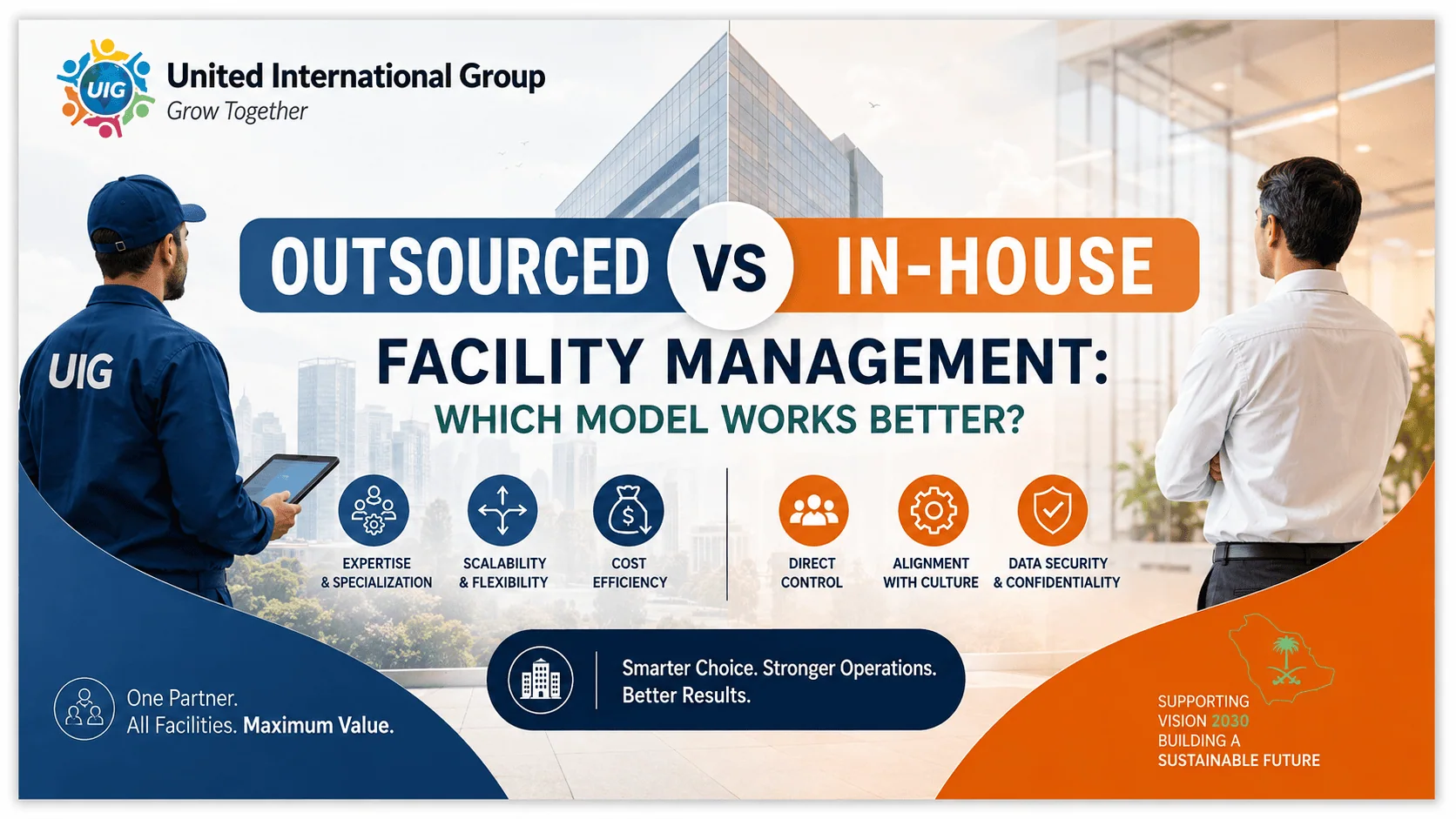
    Every facilities director eventually asks the same question: build a team, or bring in a partner who already has one? The outsourced vs in-house FM decision affects your budget, your compliance exposure, and how fast problems actually get fixed when something breaks at 2 a.m.

    There’s no universal right answer. A 12-branch retail chain in Riyadh has different needs than a single manufacturing plant in Jubail. What matters is understanding the real trade-offs — not the marketing version of either model — so the decision fits your building, your risk tolerance, and your growth plans.

    This guide breaks down both models honestly, including where in-house still makes sense, before looking at how integrated facility management is actually applied across Saudi Arabia today.

    What Is In-House Facility Management?

    In-house facility management means your organization directly employs the technicians, supervisors, and support staff who maintain your buildings. You control hiring, training, schedules, and equipment. The team reports to you, not to an external contract.

    This model works well when:

    • You operate a single site with predictable, specialized maintenance needs
    • Facilities work is closely tied to your core operations (a hospital’s medical gas systems, for example)
    • You have the internal capacity to manage HR, procurement, and compliance for a technical workforce

    The trade-off is scale. Every skill set — HVAC, electrical, plumbing, fire safety, cleaning, security — needs its own hire, its own training budget, and its own backup plan when someone quits.

    What Is Outsourced Facility Management?

    Outsourced facility management shifts day-to-day operations to a third-party provider under a service agreement. The provider brings its own trained workforce, equipment, vendor network, and reporting systems. You define the service levels; they deliver against them.

    Most providers offer this through two tracks:

    • Hard FM — building-critical systems like HVAC, electrical, plumbing, and fire safety
    • Soft FM — cleaning, landscaping, security, pest control, and waste management

    Bundled together, this is usually called Integrated Facility Management (IFM) — a single point of accountability instead of a dozen separate vendor contracts.

    Outsourced vs In-House Facility Management: Which Model Works Better

    Outsourced vs In-House Facility Management: Side-by-Side Comparison

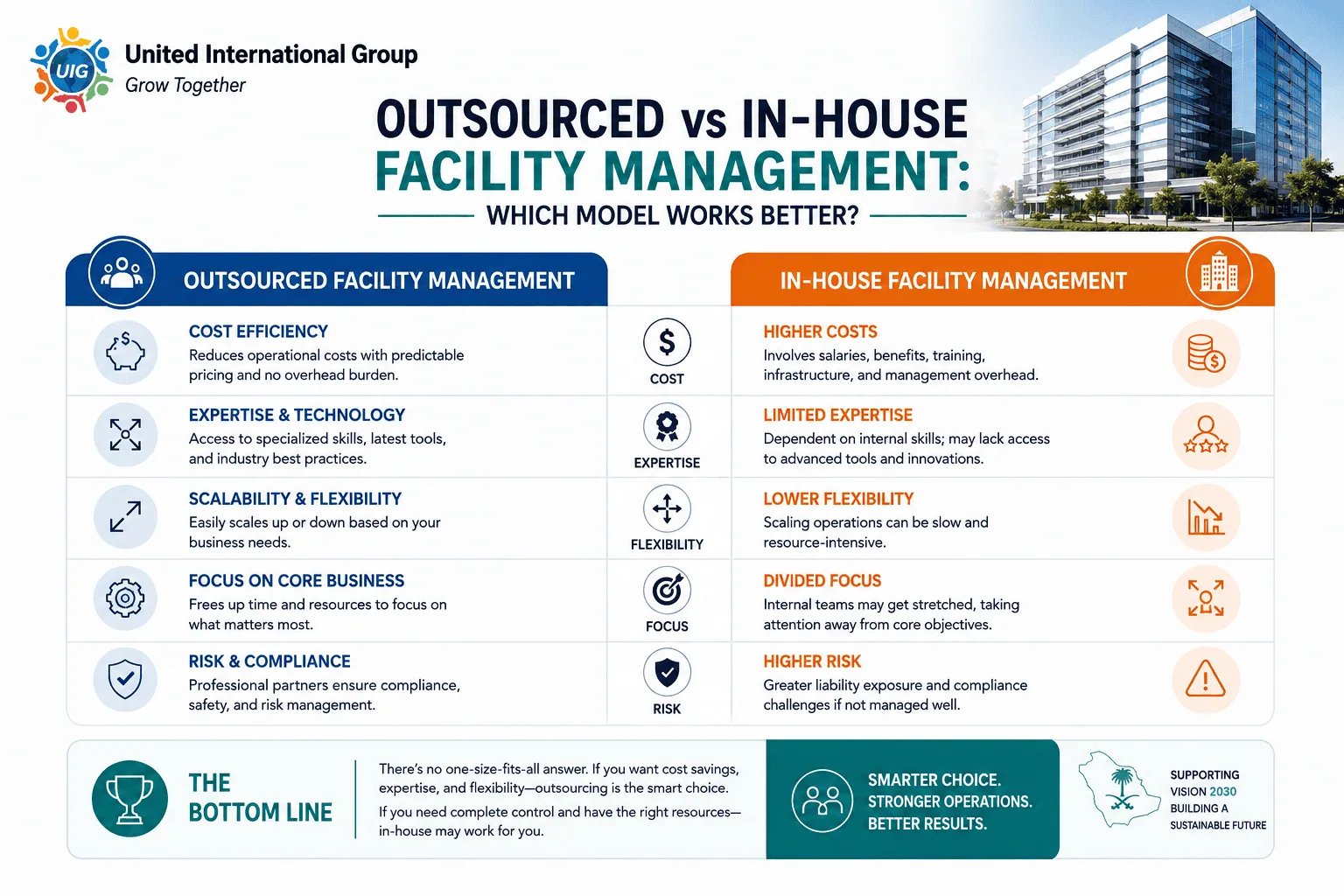
    FactorIn-House FMOutsourced FM
    Upfront costHigh — hiring, training, tools, vehiclesLower — provider already has the workforce and equipment
    Cost predictabilityVariable — overtime, turnover, emergency repairsFixed under a service contract, with clear SLAs
    Speed to scaleSlow — recruitment and onboarding take monthsFast — provider adds coverage as your portfolio grows
    Access to specialistsLimited to what you can afford to hire full-timeBroad — providers maintain multi-disciplinary teams
    Compliance and auditsFalls entirely on your internal teamShared with a provider who tracks it across many sites
    Direct oversightFull, day-to-day controlGoverned through SLAs and regular reporting
    Best suited forSingle-site, highly specialized operationsMulti-site portfolios, retail, healthcare, industrial, commercial real estate

    A 2023 industry estimate from IFMA put global outsourced FM spending growth at roughly 6-8% annually, driven largely by organizations consolidating vendors into single IFM contracts to reduce administrative overhead.

    Where In-House Still Wins

    Outsourcing isn’t automatically better. In-house FM tends to outperform when:

    • The site is highly specialized. A pharmaceutical cleanroom or a data center with unique environmental controls often needs staff who live and breathe that one system, not a generalist FM rotation.
    • Response time is measured in minutes, not hours. Some critical-operations sites can’t tolerate any handoff delay, even a well-managed one.
    • The organization is small enough that one multi-skilled caretaker covers everything. Below a certain size, outsourcing overhead isn’t worth it.

    The honest answer is that scale is usually the deciding factor. Below a certain portfolio size, in-house is leaner. Above it, the coordination cost of running your own FM department starts to outweigh the savings.

    Why Multi-Site Organizations in Saudi Arabia Lean Toward Outsourcing

    Saudi Arabia’s commercial and industrial growth continues alongside the Kingdom’s broader Saudi Vision 2030 transformation agenda.— from Riyadh’s expanding office and retail footprint to Jeddah’s logistics corridors and Jubail’s industrial base — has pushed many organizations past the point where in-house FM scales efficiently.

    A facility manager overseeing five branches in Riyadh and two in Jeddah doesn’t just need more staff — they need consistent service standards across cities, unified reporting, and a single vendor who’s accountable end-to-end rather than five separate local contractors with five different quality bars.

    This is where integrated facility management earns its place: one contract, one set of SLAs, one dashboard for compliance and asset history, instead of a patchwork of local suppliers each managing their own slice of the building.

    Practical example: A retail group operating stores across Riyadh, Jeddah, and Dammam typically saves significant coordination time by moving from separate local cleaning, security, and maintenance vendors per city to one IFM provider managing all three under a shared SLA — because incident reports, preventive maintenance schedules, and compliance documentation live in one system instead of three.

    Cost: What Actually Gets Compared

    Cost comparisons between outsourced and in-house FM often go wrong because they only compare salaries against contract fees. A fuller comparison includes:

    • Recruitment and training costs for in-house staff
    • Turnover and coverage gaps when technicians leave
    • Equipment purchase versus provider-supplied tools
    • Emergency repair markups versus fixed-fee contracts
    • Compliance and audit preparation time

    Outsourced FM tends to convert variable, unpredictable costs into a fixed, budgetable line item. In-house FM tends to offer lower cost per hour of labor but higher exposure to gaps, overtime, and specialist shortages.

    How to Decide Which Model Fits Your Facility

    Ask these questions before choosing:

    1. How many sites do you operate, and in how many cities? More than two or three locations usually tips the balance toward outsourcing.
    2. How specialized is your equipment? Highly proprietary systems may need dedicated in-house expertise.
    3. Can your team absorb HR and compliance overhead for technical staff? If not, that’s a hidden cost of staying in-house.
    4. Do you need Hard FM, Soft FM, or both? Bundling both under one IFM provider usually reduces coordination cost versus managing them separately.
    5. What’s your tolerance for variable costs? Fixed-fee contracts suit organizations that need predictable budgeting.

    Since 2011, UIG has worked through exactly this decision with clients across Saudi Arabia — helping some transition fully to outsourced IFM, and helping others build hybrid models where specialized in-house staff work alongside an outsourced soft FM team. There’s no one-size answer; there’s a right fit for your portfolio.

    Conclusion

    The choice between outsourced and in-house facility management isn’t about which model is universally better — it’s about which one fits the size, complexity, and geographic spread of your operation. Single-site, highly specialized facilities often still do well running things in-house. Multi-site portfolios across cities like Riyadh, Jeddah, and Jubail generally get more consistency and cost predictability from an integrated outsourced model.

    UIG has been delivering integrated facility management services across Saudi Arabia since 2011, working with clients to design the FM model that actually matches their operations — whether that’s full outsourcing, a hybrid setup, or a phased transition from an internal team. Contact UIG to discuss which approach fits your facility.

    Frequently Asked Questions

    Q. What is the main difference between outsourced and in-house facility management?

    In-house FM means your organization directly employs and manages the maintenance team. Outsourced FM means a third-party provider delivers those services under a contract with defined service levels.

    Q. Is outsourced facility management cheaper than in-house?

    Usually yes for multi-site or mid-to-large operations, once you factor in recruitment, training, turnover, and equipment costs — not just hourly wages. Single-site, highly specialized operations sometimes find in-house more cost-effective.

    Q. What is Integrated Facility Management (IFM)?

    IFM bundles Hard FM (HVAC, electrical, plumbing, fire safety) and Soft FM (cleaning, security, landscaping, pest control) under one provider and one contract, instead of managing separate vendors for each service.

    Q. When should a company outsource facility management?

    Outsourcing tends to make sense once an organization operates multiple sites, needs specialist coverage it can’t justify hiring full-time, or wants predictable, fixed FM costs instead of variable in-house overhead.

    Q. Can a company use a hybrid model of both in-house and outsourced FM?

    Yes. Many organizations keep highly specialized or safety-critical roles in-house while outsourcing broader Hard FM and Soft FM services to a provider — this is common in healthcare and industrial facilities.

    Q. Does outsourcing facility management mean losing control over quality?

    Not if the contract is structured properly. Service Level Agreements (SLAs), regular reporting, and defined KPIs give you measurable oversight — often more structured than informal in-house tracking.

    Q. What industries benefit most from outsourced facility management?

    Retail chains, healthcare networks, commercial real estate, and industrial facilities with multiple sites typically see the biggest gains, since outsourcing scales more efficiently than building an internal FM department at each location.

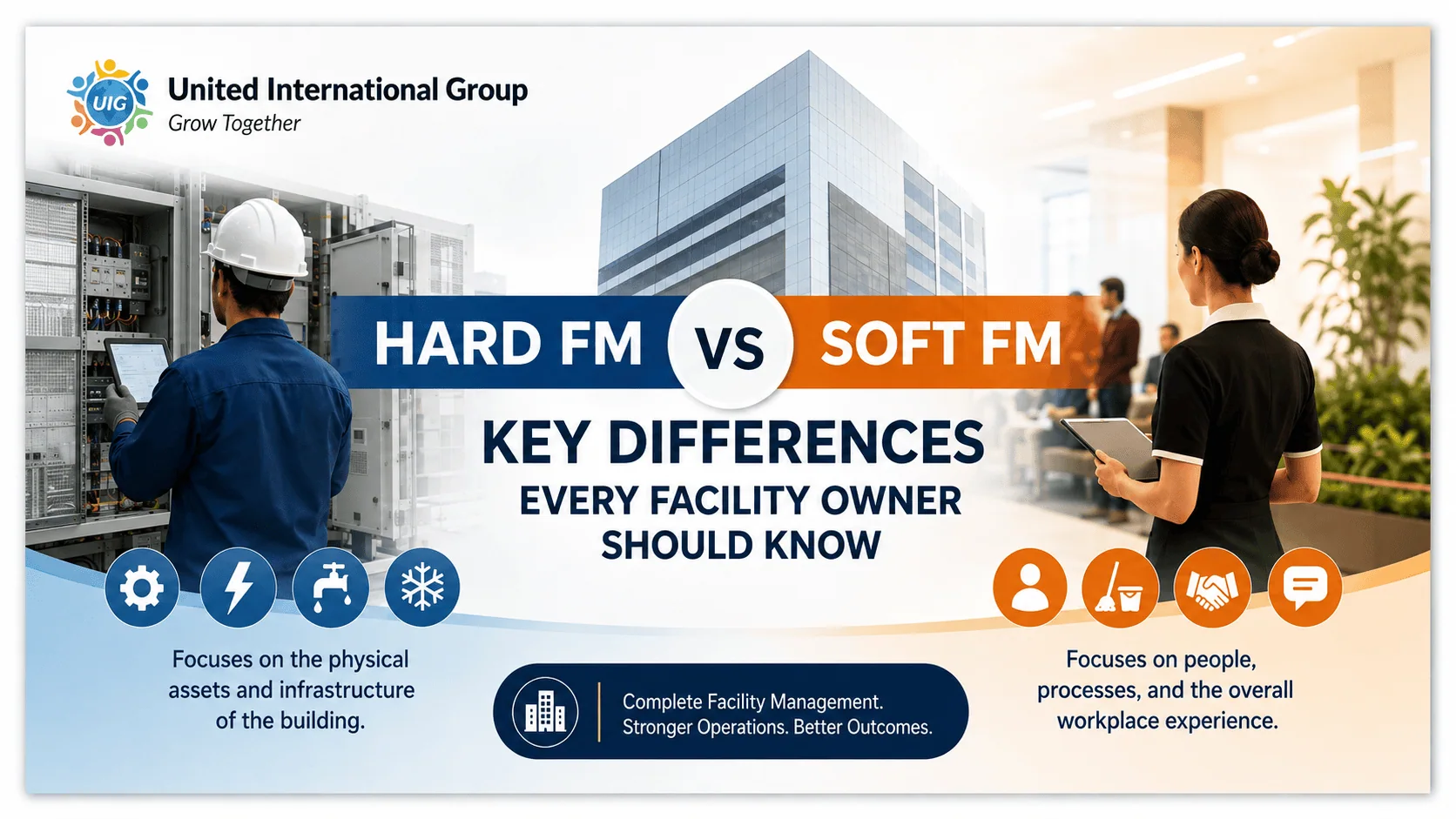
  • Hard FM vs Soft FM: Key Differences Every Facility Owner Should Know

    Hard FM vs Soft FM: Key Differences Every Facility Owner Should Know

    Facility management is no longer just about keeping a building clean or fixing equipment after it fails. For commercial buildings, hospitals, hotels, warehouses, offices, malls, schools, and industrial facilities, the real question is: who is protecting the asset, the people, and the daily operation? That is where understanding Hard FM vs Soft FM becomes important.

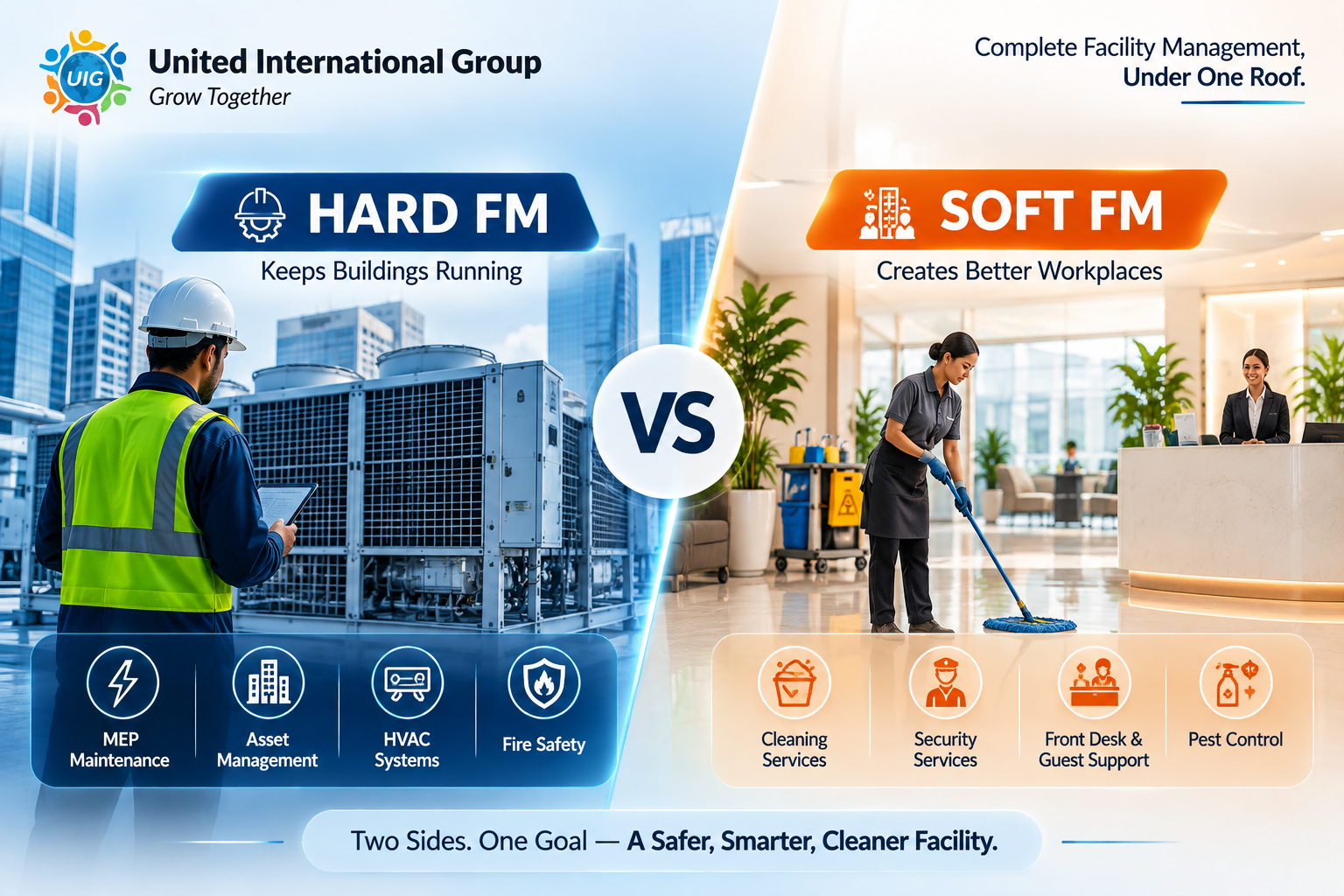
    Hard FM covers the physical systems that keep a building safe and operational, such as HVAC, electrical, plumbing, fire systems, elevators, and mechanical equipment. Soft FM covers people-facing services such as cleaning, security, landscaping, pest control, waste management, reception support, and hygiene.

    When both work together, facilities run smoothly. When one is ignored, costs rise, compliance risks increase, and the user experience suffers.

    What Is Hard FM?

    Hard FM means the technical and physical maintenance of a building’s fixed assets. Organizations can also use the ISO 41001:2018 facility management standard as a framework for establishing an effective FM management system.

    These are the systems that are usually connected to safety, compliance, infrastructure, and business continuity. If Hard FM fails, the building may become unsafe, uncomfortable, non-compliant, or even temporarily unusable.

    Common Hard FM services include:

    • HVAC maintenance
    • Electrical maintenance
    • Plumbing systems
    • MEP maintenance
    • Fire fighting system inspection and maintenance
    • Elevator installation and maintenance
    • Building automation systems
    • Industrial automation and storage systems
    • Civil works and technical repairs
    • Preventive and corrective maintenance
    • Energy and asset performance monitoring

    A simple example: if an office tower in Jeddah has poor HVAC maintenance, employees may experience discomfort, equipment rooms may overheat, energy bills may rise, and tenants may complain. That is a Hard FM issue because it affects the building’s core operating systems.

    What Is Soft FM?

    Soft FM means the non-technical services that improve the cleanliness, safety, comfort, appearance, and day-to-day experience of a facility.

    These services may not always be part of the building structure, but they directly affect how people feel inside the space. Soft FM is especially important in customer-facing environments such as hotels, malls, healthcare facilities, schools, offices, showrooms, and restaurants.

    Common Soft FM services include:

    • Cleaning services
    • Security services
    • Pest control
    • Landscaping
    • Waste management
    • Reception and front-of-house support
    • Workforce solutions
    • Event support
    • Hygiene management
    • Janitorial support
    • Facility support staff

    For example, a retail showroom may have perfect lighting, air conditioning, and electrical systems, but if the floors are dirty, washrooms are poorly maintained, pest control is weak, and waste is not managed properly, the customer experience will still suffer. That is a Soft FM failure.

    Hard FM vs Soft FM: Key Differences Every Facility Owner Should Know

    Hard FM vs Soft FM: Key Differences

    Hard FM and Soft FM both support the same goal: a safe, efficient, and well-managed facility. The difference lies in what they manage.

    FactorHard FMSoft FM
    Main focusBuilding systems and infrastructurePeople, cleanliness, comfort, and daily support
    ExamplesHVAC, MEP, fire systems, elevators, plumbing, electricalCleaning, security, pest control, landscaping, waste management
    Risk if ignoredDowntime, safety issues, compliance failures, asset damagePoor hygiene, weak user experience, complaints, reputational damage
    Skill typeTechnical engineers, electricians, MEP teams, certified techniciansCleaning staff, security teams, supervisors, support staff
    FrequencyScheduled maintenance, inspections, reactive repairsDaily, weekly, shift-based, seasonal, or event-based
    Business impactProtects assets and operational continuityImproves occupant satisfaction and brand perception
    Compliance linkStrongly linked to safety, civil defense, and technical standardsLinked to hygiene, safety, workplace standards, and customer experience

    The easiest way to remember it is this:

    Hard FM keeps the building working. Soft FM keeps the building usable, clean, safe, and pleasant.

    Why Both Hard FM and Soft FM Matter in Saudi Arabia

    Saudi Arabia’s commercial, hospitality, logistics, healthcare, education, and industrial sectors are growing quickly. With this growth, facilities are becoming larger, more complex, and more service-sensitive.

    A modern facility in Jeddah, Riyadh, or the Eastern Province may include HVAC systems, elevators, fire fighting systems, access control, automation, commercial kitchens, storage areas, digital signage, video walls, data rooms, landscaped outdoor areas, and high-footfall public spaces.

    This creates two operational needs:

    1. Technical reliability through Hard FM
    2. Daily service quality through Soft FM

    For example, in a mall or showroom, digital signage and commercial display systems need stable electrical support, cooling, preventive maintenance, and safe installation. That is Hard FM. But the same space also needs clean floors, clear waste disposal, pest prevention, security presence, and polished visitor areas. That is Soft FM.

    One without the other creates gaps.

    Practical Examples of Hard FM and Soft FM Working Together

    1. Corporate Offices

    Hard FM keeps HVAC, lighting, electrical systems, plumbing, and elevators working. Soft FM keeps the space clean, secure, hygienic, and presentable for employees and visitors.

    When both are managed well, productivity improves and complaints reduce.

    2. Healthcare Facilities

    Hard FM supports critical systems such as ventilation, electrical reliability, plumbing, elevators, fire safety, and emergency systems. Soft FM supports cleaning, disinfection, waste segregation, pest control, and patient-facing support.

    In healthcare, the margin for error is small. A weak FM strategy can affect safety, hygiene, and patient trust.

    3. Hotels and Resorts

    Hard FM protects guest comfort through air conditioning, hot water, lighting, elevators, fire systems, and room maintenance. Soft FM supports housekeeping, landscaping, pest control, waste handling, security, and event support.

    For hospitality brands, FM directly affects guest reviews and repeat bookings.

    4. Warehouses and Industrial Facilities

    Hard FM manages mechanical systems, electrical infrastructure, automation, fire systems, storage equipment, loading areas, and asset maintenance. Soft FM manages cleaning, pest control, waste, security, workforce support, and site discipline.

    For industrial operations, good FM reduces downtime and supports safety compliance.

    5. Retail and Showrooms

    Hard FM supports lighting, HVAC, electrical systems, escalators, display technology, digital signage, video walls, and fire safety. Soft FM supports cleanliness, security, landscaping, waste, washroom hygiene, and customer-facing support.

    This is where facility management becomes part of the customer experience.

    Which Is More Important: Hard FM or Soft FM?

    Hard FM and Soft FM are equally important, but their impact is different.

    Hard FM is usually more compliance-critical because it protects the physical infrastructure and safety systems of a building. In Saudi Arabia, this includes compliance considerations related to fire prevention and protection under the Civil Defense requirements and Saudi Building Code. If electrical systems, fire fighting systems, elevators, or HVAC fail, the impact can be immediate and serious.

    Soft FM is more experience-critical because it affects how people interact with the space every day. Cleanliness, security, pest control, landscaping, and hygiene shape trust, comfort, and brand perception.

    The best approach is not choosing one over the other. It is integrating both.

    How Integrated Facility Management Solves the Gap

    Integrated facility management brings Hard FM and Soft FM under one coordinated structure. Instead of managing separate vendors for cleaning, MEP, pest control, landscaping, fire systems, waste, and facility audits, businesses work with one accountable partner.

    This helps reduce:

    • Communication gaps
    • Vendor overlap
    • Delayed response times
    • Inconsistent service quality
    • Hidden operational costs
    • Compliance risks
    • Poor reporting visibility

    For multi-site companies, this matters even more. A business with offices in Jeddah, Riyadh, and Jubail needs consistent standards, clear SLAs, trained teams, and reliable escalation.

    UIG has been serving clients since 2011 and provides 14 integrated services across Saudi Arabia, including integrated facility management, cleaning, pest control, landscaping, MEP maintenance, fire fighting, elevator maintenance, waste management, IT and CAFM solutions, facility audits, workforce solutions, and project support.

    Expert Insight: The Real Cost Is Usually in the Gaps

    Many facility owners focus only on visible costs: cleaning contracts, repair bills, maintenance teams, or emergency callouts.

    But the real cost often appears in the gaps between services.

    For example:

    • Cleaning teams notice a water leak but have no direct maintenance escalation.
    • HVAC issues increase energy bills because preventive maintenance is delayed.
    • Pest control fails because waste management is inconsistent.
    • Fire systems are installed but not maintained properly.
    • Security teams report issues, but there is no structured CAFM tracking.
    • Multiple vendors blame each other instead of solving the problem.

    This is why integrated FM is becoming more valuable. It connects people, assets, systems, reporting, and accountability.

    When Should a Business Review Its FM Model?

    A business should review its facility management model when service issues become frequent or costs become difficult to control.

    Common warning signs include:

    • Repeated HVAC, electrical, plumbing, or elevator issues
    • Frequent tenant, guest, or employee complaints
    • Poor cleaning consistency
    • Pest problems despite regular treatment
    • Rising emergency repair costs
    • No clear asset maintenance history
    • Weak vendor coordination
    • Missed inspections or compliance concerns
    • No digital reporting or CAFM visibility
    • Facility teams reacting instead of planning

    If these signs are present, the issue may not be one vendor. The issue may be the structure of the FM model itself.

    How to Choose the Right FM Partner

    Choosing the right facility management partner is not only about price. It is about operational reliability, compliance, responsiveness, and long-term value.

    Look for an FM partner that can provide:

    • Experience across different industries
    • Strong Hard FM and Soft FM capabilities
    • Preventive maintenance planning
    • Trained and supervised teams
    • 24/7 support for critical issues
    • Clear SLAs and reporting
    • Compliance with local regulations
    • Facility audits and improvement plans
    • Digital visibility through CAFM
    • Ability to scale across multiple locations

    UIG operates as a multi-service facility management provider headquartered in Jeddah, with operations across key regions in Saudi Arabia.

    Conclusion: Hard FM vs Soft FM Comes Down to Asset Protection and Experience

    Understanding Hard FM vs Soft FM helps business owners, facility managers, and operations leaders make better decisions about safety, compliance, cost control, and service quality.

    Hard FM protects the building’s technical systems. Soft FM protects the people experience inside and around the building. Integrated facility management connects both, giving companies one structure, one accountable partner, and better control over daily operations.

    For businesses in Jeddah, Riyadh, the Eastern Province, and across Saudi Arabia, UIG brings the experience, service range, and operational capability needed to manage facilities with confidence.

    Looking for a facility management partner that can handle both Hard FM and Soft FM under one integrated service model? Contact UIG today to request a customized facility management proposal.

    Frequently Asked Questions

    1. What is the difference between Hard FM and Soft FM?

    Hard FM manages the physical systems of a building, such as HVAC, electrical, plumbing, fire systems, and elevators. Soft FM manages people-facing services such as cleaning, security, landscaping, pest control, and waste management.

    2. What are examples of Hard FM services?

    Examples of Hard FM services include MEP maintenance, HVAC servicing, electrical repairs, plumbing, fire fighting system maintenance, elevator maintenance, building automation, and preventive asset maintenance.

    3. What are examples of Soft FM services?

    Examples of Soft FM services include cleaning, security, pest control, landscaping, waste management, reception support, housekeeping, event support, and workforce solutions.

    4. Is cleaning a Hard FM or Soft FM service?

    Cleaning is Soft FM service because it supports hygiene, comfort, appearance, and user experience rather than the fixed technical infrastructure of the building.

    5. Is HVAC maintenance Hard FM or Soft FM?

    HVAC maintenance is Hard FM because it involves the technical system that controls heating, ventilation, air conditioning, comfort, and indoor air quality.

    6. Why do businesses need both Hard FM and Soft FM?

    Businesses need both because Hard FM protects building systems and compliance, while Soft FM protects cleanliness, safety, comfort, and daily user experience. Together, they reduce risk and improve operational performance.

    7. What is integrated facility management?

    Integrated facility management means managing multiple facility services under one coordinated contract, team, SLA, and reporting structure. It improves accountability and reduces vendor management complexity.

    8. Which industries need Hard FM and Soft FM?

    Industries such as commercial real estate, hospitality, healthcare, education, retail, logistics, manufacturing, government, and food and beverage need both Hard FM and Soft FM.

    9. When should a company outsource facility management?

    A company should consider outsourcing FM when internal teams struggle with maintenance, compliance, cleaning quality, vendor coordination, emergency response, or multi-site consistency.

  • Integrated Facility Management: What It Means and Why It Matters in KSA

    Integrated Facility Management: What It Means and Why It Matters in KSA

    Running a facility looks simple from the outside. The lights work. The AC runs. The building is clean. The lifts move. Security is present. Waste is removed. Nothing looks broken.

    But anyone who manages a commercial building, hospital, hotel, school, warehouse, or government facility knows the truth: keeping all of this running is not simple. That is where Integrated Facility Management comes in.

    Instead of dealing with five, ten, or fifteen different vendors for cleaning, MEP maintenance, pest control, landscaping, fire safety, waste management, and emergency repairs, integrated facility management brings these services under one coordinated system.

    In Saudi Arabia, this matters even more now. With Vision 2030 driving growth across real estate, hospitality, healthcare, education, logistics, and public infrastructure, facilities cannot afford slow response, poor coordination, or unclear accountability.

    What Is Integrated Facility Management?

    Integrated Facility Management is the management of multiple facility services through one coordinated partner, one operating structure, and one clear accountability system.

    In simple terms, it means your facility is not being managed in pieces.

    Cleaning is not separate from maintenance. Maintenance is not separate from compliance. Compliance is not separate from safety. Every service works together.

    A proper IFM model usually includes:

    • Hard services such as MEP maintenance, HVAC, electrical systems, plumbing, fire safety, elevators, and technical repairs
    • Soft services such as cleaning, pest control, landscaping, waste management, housekeeping, and support staff
    • Digital systems such as CAFM, reporting dashboards, audits, and performance tracking
    • Emergency response and planned preventive maintenance

    For business owners and operations teams, the biggest difference is simple:

    You stop chasing vendors. You get one accountable team responsible for the facility’s performance.

    Why Integrated Facility Management Matters in Saudi Arabia

    Saudi Arabia is not operating at yesterday’s pace.

    Riyadh is attracting regional headquarters. Jeddah continues to grow as a commercial and logistics hub. Jubail remains critical for industrial operations. Tourism, hospitality, healthcare, education, retail, and public infrastructure are all expanding under Vision 2030.

    That growth creates a new kind of pressure on facilities.

    • A hotel cannot afford poor housekeeping standards.
    • A hospital cannot afford delayed maintenance.
    • A warehouse cannot afford downtime.
    • A commercial tower cannot afford inconsistent cleaning, AC complaints, or safety gaps.

    This is why Integrated Facility Management is becoming more important across KSA. It helps organizations manage complexity without adding more internal burden.

    Integrated Facility Management: What It Means and Why It Matters in KSA

    Traditional FM vs Integrated Facility Management

    Many businesses still manage facilities the old way: one vendor for cleaning, another for maintenance, another for pest control, another for landscaping, and another for emergency repairs. That works for a while. Then something breaks.

    The cleaning team blames the maintenance team. The maintenance vendor says the issue came from another contractor. The procurement team gets stuck between invoices, delays, and complaints.

    Integrated Facility Management solves this by putting responsibility in one place.

    AreaTraditional Facility ManagementIntegrated Facility Management
    Vendor managementMultiple vendorsOne coordinated partner
    AccountabilityOften unclearClearly defined
    ReportingSeparate reportsUnified reporting
    Cost controlHarder to trackEasier to monitor
    Response timeSlower due to handoffsFaster coordination
    ComplianceScattered responsibilityCentralized oversight
    Best forSmall, simple sitesMulti-service, multi-site operations

    If your team is spending more time managing vendors than managing the business, UIG can help you simplify facility operations with one integrated service model.

    Benefits of Integrated Facility Management

    One Partner Takes Responsibility

    The biggest benefit of IFM is accountability.

    When something goes wrong, you do not need to figure out which vendor is responsible. One partner owns the coordination, response, reporting, and follow-up.

    For facility managers, this saves time.

    For procurement teams, it simplifies contracts.

    For leadership, it creates better visibility.

    Better Control Over Costs

    Facility costs often rise quietly.

    A small repair here. Extra manpower there. Emergency maintenance every few weeks. Duplicate vendor charges. Unclear scope.

    Integrated Facility Management helps bring these costs into view.

    Because all services are managed together, it becomes easier to see where money is being wasted, where preventive maintenance can reduce emergency repairs, and where service levels need to be adjusted.

    Faster Emergency Response

    In Saudi Arabia, facility issues cannot always wait until the next working day.

    AC failure, electrical faults, plumbing issues, lift problems, fire safety concerns, and hygiene issues can affect operations immediately.

    UIG provides 24/7 emergency response across KSA, which is especially important for hospitals, hotels, industrial facilities, retail spaces, and high-traffic commercial buildings.

    Stronger Compliance and Safety

    Facility management is not just about appearance.

    It is also about safety, documentation, labor compliance, insurance, inspections, and risk control.

    UIG is fully licensed and insured, follows KSA labor law requirements, and supports clients with structured audits, maintenance, and compliance-focused facility services.

    Better Experience for People Using the Space

    Good facility management is often invisible.

    People only notice it when something fails.

    When IFM works well, employees, guests, patients, students, tenants, and customers experience a cleaner, safer, more reliable environment.

    That matters for brand reputation, tenant retention, staff productivity, and customer trust.

    Industries That Need Integrated Facility Management in KSA

    Commercial Real Estate & Offices

    Office towers, corporate buildings, and business parks need clean common areas, reliable HVAC, working elevators, fast maintenance, and professional front-of-house support.

    For offices in Riyadh, Jeddah, and other business hubs, IFM helps maintain a better workplace experience while reducing daily operational pressure.

    Hospitality – Hotels & Resorts

    Hotels cannot separate facility performance from guest experience.

    A delayed maintenance request, poor cleaning standard, pest issue, AC complaint, or landscaping problem can quickly affect reviews.

    Integrated Facility Management helps hotels and resorts coordinate housekeeping support, technical maintenance, waste handling, pest control, landscaping, and emergency response through one system.

    Healthcare – Hospitals & Clinics

    Hospitals and clinics need high reliability.

    Cleanliness, MEP systems, waste management, emergency readiness, and safety compliance are all critical.

    For healthcare facilities, IFM reduces coordination gaps and supports smoother operations across clinical and non-clinical areas.

    Education – Schools & Universities

    Schools and universities manage classrooms, washrooms, outdoor areas, sports facilities, staff areas, and safety systems.

    Integrated Facility Management helps education operators maintain hygiene, safety, landscaping, maintenance, and compliance without overloading internal admin teams.

    Industrial – Factories & Warehouses

    Industrial sites in places like Jubail need strong maintenance discipline.

    A small technical issue can affect production, storage, safety, or delivery timelines.

    IFM helps factories and warehouses manage MEP maintenance, pest control, waste handling, fire safety, automation support, and emergency repairs in a more coordinated way.

    Retail – Malls & Showrooms

    Retail spaces need to look good and function well every day.

    Lighting, AC, washrooms, cleaning, waste removal, pest control, and safety systems all affect customer experience.

    For malls and showrooms, IFM protects both operations and brand image.

    Government & Municipality

    Government and municipal facilities need reliable service standards, public cleanliness, safety, documentation, and planned maintenance.

    Integrated Facility Management gives public-sector teams better control, better reporting, and clearer accountability.

    Food & Beverage – Restaurants & Catering

    Restaurants, cafes, cloud kitchens, and catering units depend heavily on hygiene, pest control, waste management, equipment up time, and fast maintenance.

    One weak area can affect customer trust or compliance.

    IFM helps food and beverage operators keep these services connected and properly monitored.

    How to Choose the Right Integrated Facility Management Partner

    Check the Service Range

    A serious IFM partner should offer more than basic cleaning or manpower.

    Look for Local KSA Coverage

    Saudi Arabia is large. A provider that works only in one city may not be enough for multi-site businesses.

    UIG supports operations across Jeddah, Riyadh, Jubail, and wider KSA, with international partnerships across India, UAE, China, and Morocco.

    Ask About Emergency Support

    Facility issues are not always predictable.

    Before choosing a provider, ask:

    • Do they offer 24/7 emergency response?
    • Can they mobilize quickly?
    • Do they have trained teams?
    • Are they licensed and insured?
    • Can they handle both planned and urgent work?

    UIG meets these core requirements for businesses that need dependable facility support.

    Review Workforce Strength

    People make or break facility management.

    UIG has sourced talent from 22+ nationalities, supported 2000+ individual placements, and works through 20+ overseas recruitment offices. This gives the company stronger workforce access for large-scale and specialized facility requirements.

    Ask for Reporting and Accountability

    A good IFM partner should not only “do the work.”

    They should also show what was done, what needs attention, what risks exist, and where costs can be improved.

    That is where CAFM, audits, reports, and performance reviews become useful.

    Conclusion

    Integrated Facility Management is not just a cleaner way to manage vendors. It is a better way to run facilities.

    For businesses in Saudi Arabia, especially those operating across Jeddah, Riyadh, Jubail, and other growing business hubs, IFM helps reduce confusion, improve response time, strengthen compliance, and protect the experience of everyone using the space.

    United International Group has been serving Saudi Arabia since 2011, with 14+ integrated services, 24/7 emergency response, full licensing and insurance, and a Vision 2030-aligned operating model. With 20+ corporate clients, 22+ nationalities sourced, 2000+ individual placements, and 20+ overseas recruitment offices, UIG brings both facility expertise and workforce strength to the table.

    If your facility operations feel scattered, slow, or too dependent on multiple vendors, it may be time to move to an integrated model.

    UIG Blog CTA – Integrated Facility Management

    Talk to UIG

    Stop Managing Vendors. Start Managing Performance.

    One partner, 14+ integrated services, and 24/7 emergency response across Jeddah, Riyadh, Jubail, and wider KSA.

    Frequently Asked Questions

    Q. What is Integrated Facility Management?

    Integrated Facility Management is a model where multiple facility services are managed by one coordinated partner. This includes services like cleaning, MEP maintenance, pest control, landscaping, waste management, fire safety, audits, and reporting.

    Q. Why is Integrated Facility Management important in Saudi Arabia?

    It is important because Saudi Arabia’s commercial, hospitality, healthcare, industrial, and public infrastructure sectors are growing quickly under Vision 2030. Larger and more complex facilities need better coordination, faster response, and stronger accountability.

    Q. What services are included in Integrated Facility Management?

    Common IFM services include cleaning, MEP maintenance, HVAC support, pest control, landscaping, fire safety, elevator maintenance, waste management, audits, workforce solutions, and CAFM reporting.

    Q. How is IFM different from traditional facility management?

    Traditional facility management often uses multiple separate vendors. IFM brings services under one partner, one contract, one reporting structure, and one accountability system.

    Q. Which industries benefit most from IFM?

    Commercial offices, hotels, hospitals, schools, universities, factories, warehouses, malls, showrooms, government facilities, municipalities, restaurants, and catering businesses benefit strongly from IFM.

    Q. Does Integrated Facility Management reduce costs?

    Yes. IFM can reduce costs by improving vendor coordination, lowering duplicate work, reducing emergency repairs, improving preventive maintenance, and giving better visibility into total facility spending.

    Q. Why should businesses avoid managing too many facility vendors?

    Too many vendors can create confusion, slower response times, unclear accountability, inconsistent service quality, and higher administrative workload.

    Q. Does UIG provide Integrated Facility Management across KSA?

    Yes. UIG provides integrated facility management services across Saudi Arabia, including Jeddah, Riyadh, Jubail, and other locations across the Kingdom.

    Q. How do I choose the right IFM company in Saudi Arabia?

    Choose a provider with strong service coverage, local KSA presence, emergency support, compliance knowledge, trained manpower, reporting systems, and proven corporate experience.